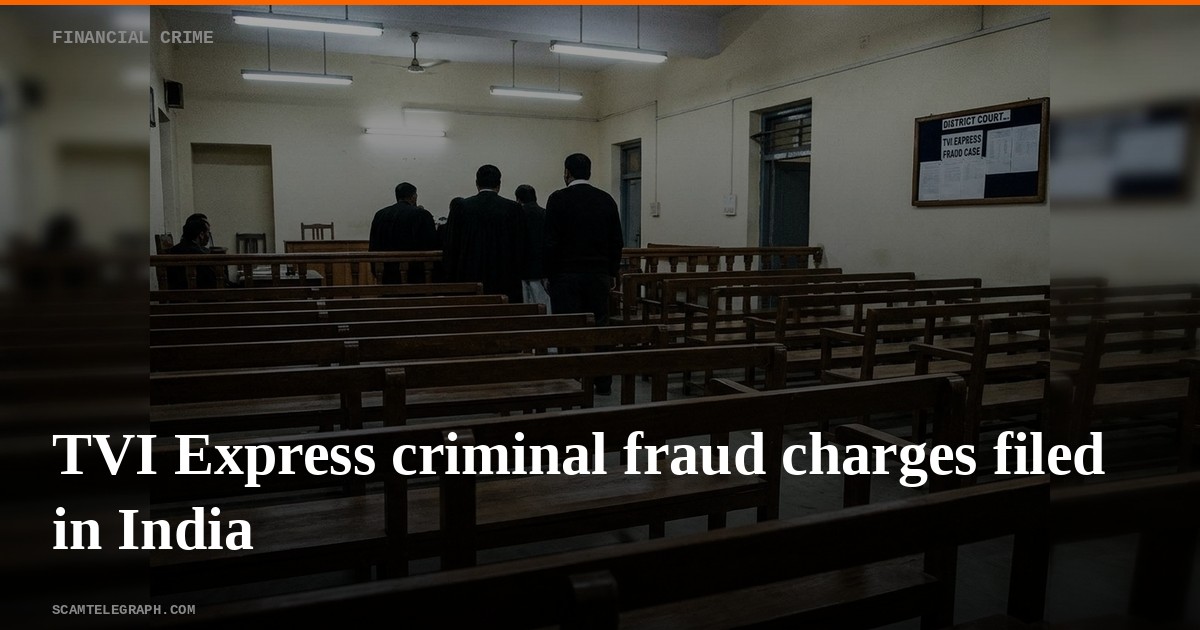
India's Central Bureau of Investigation has filed criminal charges against TVI Express founder Tarun Trikha and several associates, five years after his initial arrest. The charges, lodged in 2018, allege a massive Rs 10,000 crore fraud involving cheating, forgery, and violations of Securities and Exchange Board of India (SEBI) guidelines.
The CBI's action follows a directive from the Indian Supreme Court in 2014, which ordered a comprehensive investigation into the defunct travel-based pyramid scheme. Trikha, along with Varun Trikha, Veena Trikha, Sikha Trikha, Shakti Sharad, Anoop Kumar, and Kabita Ganguly, face accusations stemming from a complainant's allegations of widespread financial misconduct.
Investigators detailed how the accused allegedly collected vast sums under the guise of "Pacific Royal Airlines." This venture, a failed attempt by Trikha to launch an airline, is now suspected of being a front to launder funds appropriated through TVI Express. The complainant specifically alleged that over Rs 10,000 crore of investor funds were siphoned and misappropriated through these schemes.
A critical component of the alleged fraud involved a purported software system. This program, promised to investors as a means to redeem their investments, never functioned as advertised. Victims found themselves unable to access or recover their funds, trapped by a non-existent redemption mechanism.
TVI Express, though its website went offline years ago, operated as a basic travel-based pyramid scheme. Its compensation plan relied heavily on recruitment, with new investor money paying off earlier participants, a structure widely recognized as unsustainable and illegal. Independent analyses, including early reports by ScamTelegraph in 2010, identified TVI Express as a clear pyramid scheme, long before the current charges were filed.
The scale of the alleged fraud, exceeding Rs 10,000 crore, represents a significant financial loss for thousands of investors across India. Such schemes often exploit a lack of financial literacy and the promise of quick, high returns, drawing participants into complex structures that ultimately collapse.
The CBI's investigation into TVI Express highlights the persistent challenges faced by Indian authorities in curbing fraudulent multi-level marketing and pyramid schemes. These operations often disguise themselves with tangible products or services, like travel packages in TVI Express's case, to circumvent regulations against direct money circulation schemes.
The Securities and Exchange Board of India has stringent rules governing collective investment schemes, requiring proper registration, transparency, and investor protection mechanisms. The alleged absence of these safeguards, coupled with the deceptive collection of funds and the non-functional redemption software, forms the core of the criminal charges.
Victims of such large-scale schemes frequently face arduous paths to recovery. The complexity of tracing siphoned funds, often moved through multiple accounts or invested in obscure assets, makes restitution a lengthy and challenging process. The CBI's charges against Tarun Trikha and his family members along with Shakti Sharad, Anoop Kumar, and Kabita Ganguly, aim to hold key orchestrators accountable for the financial damage inflicted on thousands of individuals.
The time elapsed between the scheme's active operation and the filing of charges highlights the detailed and often slow nature of prosecuting complex financial fraud cases, especially those spanning multiple jurisdictions or involving large numbers of victims. The charges emphasize the vigilance required from both regulators and the public regarding investment opportunities promising unusually high returns. Investors are consistently advised to verify the legitimacy of any scheme with appropriate financial authorities before committing funds.
The legal proceedings against Trikha and his associates continue in India, with victims awaiting potential recovery of their lost investments.
 Tarak Bajpai
 Manoj Kumar