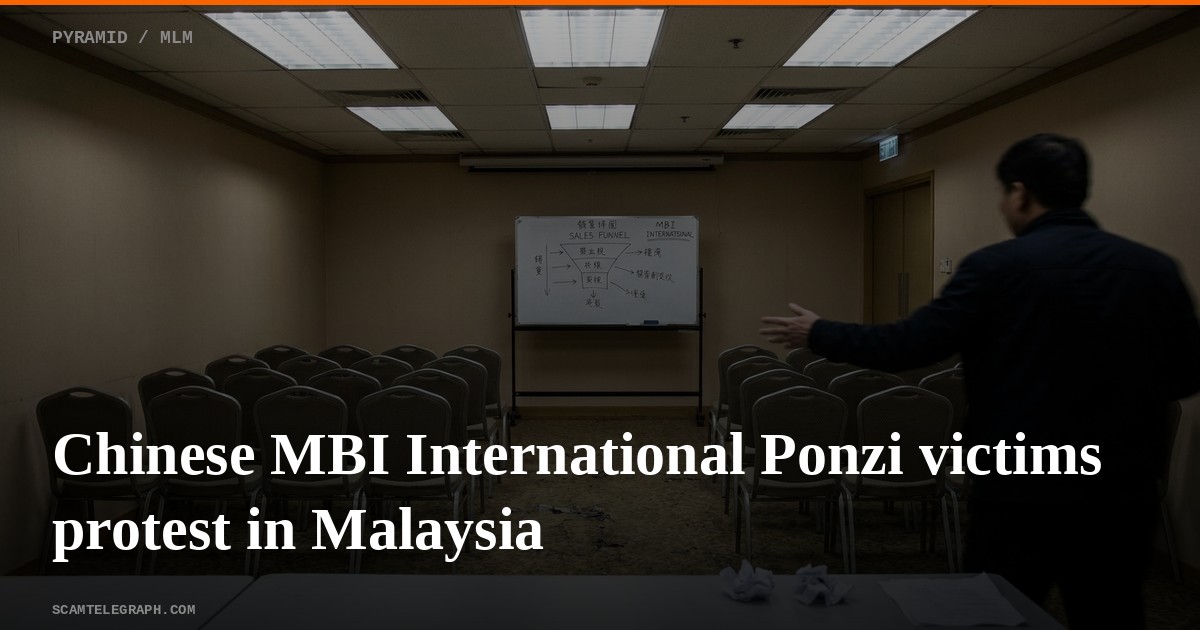
Over one hundred Chinese investors, victims of the collapsed MBI International Ponzi scheme, staged a protest outside the Chinese embassy in Kuala Lumpur, Malaysia. The demonstration followed the scheme's unraveling and the 2017 arrest of its founder, Teddy Teow, leaving many facing substantial financial losses.
These protestors had traveled specifically from various parts of mainland China, arriving in Malaysia earlier this week. They gathered to chant and sing, directly appealing to the Chinese embassy for diplomatic intervention and assistance in recovering their lost investments. Many of the alleged victims claimed they had borrowed heavily from relatives and other sources, including personal loans, to fund their MBI investments. The financial strain has been immense.
Their decision to protest at an overseas embassy, rather than in China, reflects fears of legal repercussions within their home country. Investing in unregistered multi-level marketing schemes, which are often fronts for Ponzi operations, carries significant legal risks and potential penalties for participants under Chinese law. In contrast, while MLM Ponzi schemes are equally illegal in Malaysia, investors who admit their involvement typically do not face arrest or criminal charges themselves. This jurisdictional difference guided their choice of protest location.
MBI International operated under the guise of an investment company, but functioned as a classic Ponzi scheme. It promised high, consistent returns on investments in various "projects" and "Mcoin" digital currency, which lacked any real underlying value. The scheme relied entirely on a constant influx of new investor funds to pay out earlier participants, creating an illusion of profitability and sustainability. Money flowed rapidly up the recruitment chain, from newly drawn members to their recruiters and those above them, until the system inevitably collapsed under its own weight.
Malaysian authorities initiated a crackdown on MBI International and its affiliates starting in 2017. Founder Teddy Teow, whose real name is Teow Wooi Huat, was arrested in July 2017 on suspicion of money laundering and fraud. He was formally charged in a Malaysian court last year. Investigators estimate the MBI scheme defrauded approximately 350,000 victims across several countries, siphoning off an estimated $165 million (RM700 million at the time). The scheme's reach extended through online platforms and physical recruitment events.
Recovering funds from collapsed international Ponzi schemes proves notoriously difficult for victims. Scheme founders often move stolen assets to offshore accounts, purchasing luxury properties, vehicles, or other high-value items in jurisdictions with opaque financial regulations. This makes asset tracing, freezing, and repatriation a complex and lengthy legal battle, often spanning multiple countries and legal systems. Even when assets are identified, the cost of legal action can be prohibitive for individual victims, and the recovered amounts rarely cover full losses.
The emotional and financial toll on victims of MBI International has been severe. Protestors reported that the losses had profoundly impacted their lives, leading to widespread debt, family strife, and despair. Some victims, according to reports from the protest, even resorted to suicide after realizing their investments were irrevocably lost and their financial futures ruined. The Malaysian Ministry of Domestic Trade and Consumer Affairs had previously issued warnings about MBI International's operations, placing it on a watch list for illegal schemes.
The Malaysian government has previously seized assets linked to MBI International, including luxury cars and properties, as part of its ongoing enforcement actions against the scheme.
 Boris
Boris