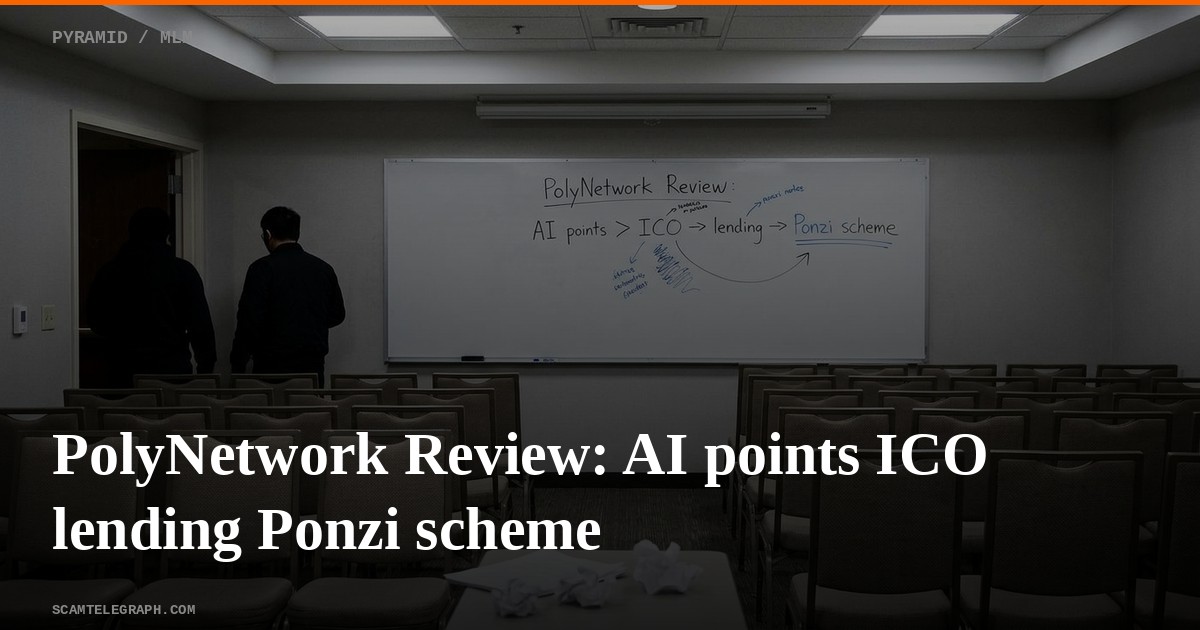
PolyNetwork, operating under the domain polynetwork.org, has maintained anonymous ownership since its private registration on October 2, 2017. This opaque structure leaves no named individuals accountable for the platform's alleged investment returns, a common tactic in suspected financial schemes. No tangible products or services are offered for sale.
PolyNetwork's entire operational model relies on affiliates recruiting new participants, who then purchase "AI points" from the platform. These "AI points" are sold to new members at a fluctuating price, typically between $1.00 and $1.60 each. Participants are then encouraged to "lend" these purchased points back to PolyNetwork, with promises of substantial returns.
The platform advertises a 45% monthly return over a 120-day period. Daily earnings reportedly vary from 0.5% to 2%, scaled by the size of the initial "investment." For instance, a $50,000 commitment supposedly yields a higher daily percentage than a $100 entry.
PolyNetwork's compensation plan heavily incentivizes recruitment. Direct referrals generate an 8% commission for the recruiter. Second-level recruits, brought in by direct referrals, yield a 2% commission, and third-level recruits provide a 1% payout.
Beyond direct referrals, the scheme employs a binary compensation system. Recruits are placed into two "legs"—a left side and a right side—under the existing member. Commissions are paid based on matching investment volume between these two sides. Affiliates with less than $10,000 in their downline investment volume receive a 3% commission on matched volume. This rate increases to 8% for those who generate $100,000 or more in downline investment. Weekly commissions are capped at $28,000 per individual, though any unmatched volume reportedly rolls over to subsequent weeks.
Further incentives exist for top recruiters. Achieving "Platinum" status, for example, requires generating $200,000 in total downline investment, with at least $100,000 originating from a single recruit. Platinum members receive a one-time bonus, and additional tiers with greater rewards are available above this level.
Financial regulators and fraud experts often identify such structures as Ponzi schemes. New investor funds are used to pay off earlier investors, rather than generating profits from legitimate business activities. This model is inherently unsustainable. And it relies entirely on a continuous influx of new money.
When recruitment inevitably slows, the flow of funds to pay existing "returns" diminishes. This typically triggers the scheme's collapse, leaving most participants, particularly those who joined later, with significant financial losses. Victims of similar schemes often report difficulties in recovering funds due to the anonymous nature of the operators and the cross-border digital transactions involved.
Authorities like the U.S. Securities and Exchange Commission (SEC) and the Financial Conduct Authority (FCA) in the UK frequently warn against investment opportunities lacking transparency and verifiable revenue streams. In 2023 alone, the SEC filed charges in dozens of cases involving alleged crypto asset securities fraud. Many of these exhibited characteristics similar to PolyNetwork's model, including promises of high, guaranteed returns and a heavy reliance on recruitment.
The fundamental mathematics of such recruitment-dependent operations dictates their eventual failure. Individuals suspecting they have been defrauded by PolyNetwork or similar platforms can report their experiences to the Federal Bureau of Investigation's Internet Crime Complaint Center (IC3).