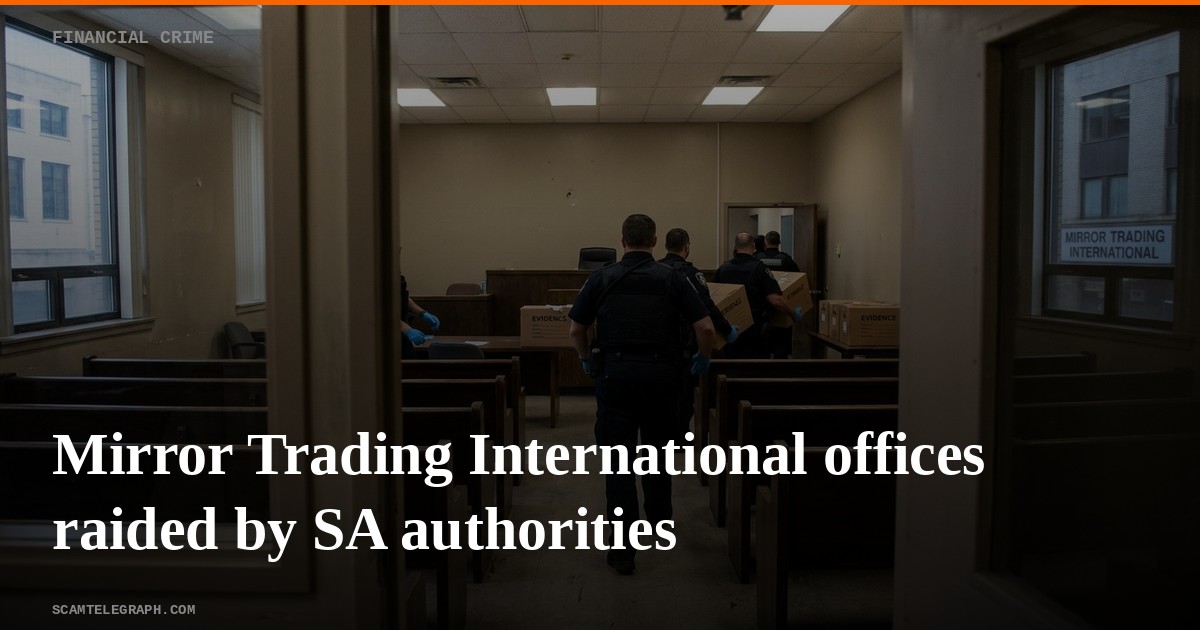
South African financial authorities recently raided the offices of Mirror Trading International across three cities. The Financial Sector Conduct Authority executed court-issued warrants at MTI locations in Stellenbosch, Polokwane, and Durban last week, signaling a significant escalation in its investigation into the trading operation.
Agents seized a range of materials during the raids. Computers, cellular phones, notebooks, and various electronic records were collected from MTI's corporate offices. Investigators also took evidence from the private residences of founders Clynton and Cheri Marks.
The FSCA, South Africa's financial watchdog, began investigating MTI after issuing a public fraud warning in August. The agency stated it would review the newly seized evidence to determine whether to pursue administrative action or refer the case for criminal prosecution.
MTI attracted investors with a simple promise: high returns, up to 10% monthly, generated by an automated trading bot. This claim raised immediate red flags for financial analysts. A data leak last month exposed MTI's substantial $80.2 million deficit, indicating the company lacked the funds to repay investors if they requested withdrawals.
The FSCA's August warning directly addressed these unrealistic promises. The agency called MTI's claimed investment returns "far-fetched and unrealistic." Independent security analysts had reached similar conclusions years prior. A 2019 review identified MTI as a Ponzi scheme based on its operational structure and impossible guaranteed returns.
MTI consistently asserted that South African financial regulations did not apply to its operations, despite operating without FSCA registration. Cheri Marks publicly dismissed regulatory scrutiny as "attacks." She distributed a voice message describing FSCA agents, accompanied by fifteen police officers, arriving at her home during breakfast to seize laptops, phones, and personal documents.
Marks herself brings a history of involvement in alleged financial schemes. Under her previous name, Cheri Ward, she helped establish BTC Global, another collapsed Ponzi scheme that left investors with significant losses. She is widely believed to manage MTI's daily operations.
Meanwhile, MTI's CEO, Johann Steynberg, has maintained public silence throughout the investigation. His absence from any public defense effort has led many to view him as a figurehead, with others directing the company's activities.
These raids mark a sharp escalation from the FSCA's initial August warning. Regulators are now actively gathering and comparing evidence, cross-referencing seized materials with information already on file. The possibility of criminal charges depends directly on what investigators uncover and whether the FSCA refers its findings to the South African Police Service.
MTI's legal exposure has widened considerably. Civil enforcement actions alone could result in asset freezes, bans on operating financial services, and personal liability for company executives. A criminal investigation adds the severe possibility of jail time for those found responsible. For investors with money still tied up in MTI, these raids suggest definitive answers about their funds are finally forthcoming, though likely not the ones they hoped to hear.