Valent D. Soisuvarn, identified as the purported CEO of HashAlpha, struggled to explain his company's compensation plan in a January 28, 2025 marketing video. This lack of transparency extends to HashAlpha's operations, which has cycled through three website domains in under two months, each experiencing abrupt shutdowns.
HashAlpha's initial domain, hashalpha.io, registered privately on November 11, 2025, was seized by its registrar, Hostzinger, on March 14, 2025. The domain received "clientHold" and "clientTransferProhibited" statuses. ICANN, the internet's governing body for domain names, defines "clientHold" as a directive for a domain's registry to prevent its activation in the DNS, effectively taking it offline. This status often signals legal disputes, non-payment, or pending deletion. "ClientTransferProhibited" blocks any attempts to move the domain to a different registrar.
HashAlpha did not disclose the domain seizure. Instead, on March 15, the company announced "temporary website maintenance" to its users. Two days later, on March 16, HashAlpha launched a new website on hashalpha.global, a domain privately registered just a week earlier, on March 9.
Hostzinger seized this second domain on March 18, applying the same "clientHold" and "clientTransferProhibited" statuses. HashAlpha again provided false information to its users. On March 17, it claimed "system maintenance" was underway. The following day, March 18, it cited "increased platform activity and demand" as the reason for disruption. As it sought another online presence, HashAlpha issued an "infrastructure update" announcement on March 19.
Later on March 19, HashAlpha reappeared on its third domain, hashalphaglobal.com, privately registered the previous day, March 18. For this iteration, the company switched registrars, moving from Hostzinger to Network Solutions. Whether Network Solutions has seized HashAlpha's third domain has not yet been determined.
The January 28, 2025 marketing video, promoted by Sal Khan on his "The Grateful Tribe" YouTube channel, introduced Valent D. Soisuvarn as HashAlpha's CEO. Khan is known for promoting numerous fraudulent MLM investment schemes. During the interview, Soisuvarn admitted he was "not too sure" about parts of HashAlpha's compensation plan, specifically stating, "That's a good question. I am not too sure about that."
Soisuvarn's social media profiles identify him as a "PlayboyCEO" from California, now residing in Bangkok, Thailand. He appears to have transitioned into the cryptocurrency sector in late 2024. Beyond HashAlpha, he holds a role as "Asia Affiliate CEO" for a US-based telehealth endoscopy firm. HashAlpha's official website does not list Soisuvarn or any other executives.
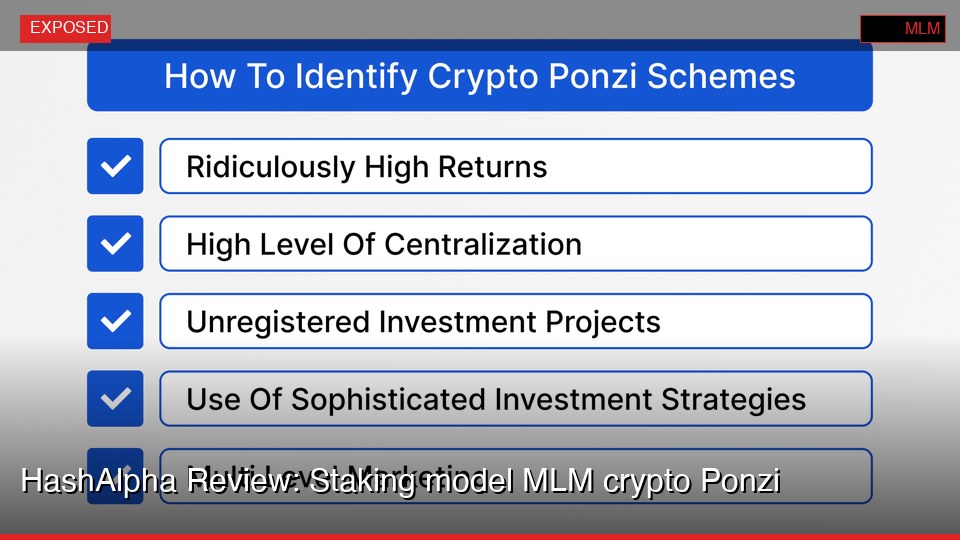
The lack of transparent executive information, combined with repeated domain seizures and misleading communication, aligns with common indicators of fraudulent investment operations, particularly Ponzi schemes. Regulators worldwide, including the U.S. Securities and Exchange Commission (SEC) and various financial conduct authorities, frequently issue warnings about investment opportunities that obscure their leadership or operational structure. Such secrecy often prevents accountability and makes it difficult for investors to perform due diligence or seek recourse. The SEC's Office of Investor Education and Advocacy often points to "unregistered sellers" and "unexplained or inconsistent delays in payments" as red flags.
Ponzi schemes rely on new investor funds to pay earlier investors, requiring a constant influx of money. This model often leads to sudden operational shutdowns when recruitment slows or regulatory scrutiny intensifies. The pattern of domain seizures and subsequent re-launches under different pretenses suggests an attempt to evade detection and maintain the illusion of continuity for existing and potential investors. Victims of similar schemes often face significant challenges in recovering their funds, particularly when the operators are based internationally and frequently change their operational details.
Potential investors should exercise extreme caution with any company that operates without disclosing its ownership or executive team, especially those experiencing frequent, unexplained website disruptions. The U.S. Federal Trade Commission provides resources for reporting scams and offers guidance on how to protect against investment fraud at reportfraud.ftc.gov.