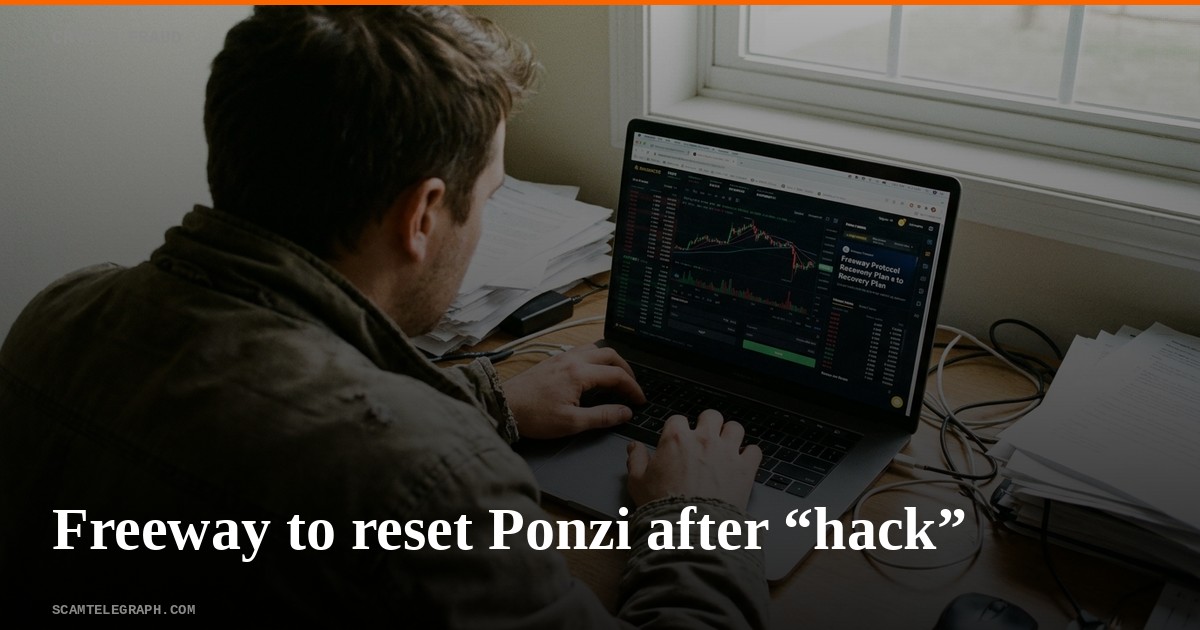
On July 13th, Coffe Network announced one of Freeway's digital asset "bridges" had been compromised the previous day. This breach led to a significant number of FWT tokens being removed from a hot wallet and sold, triggering extreme volatility in the token's market value.
Freeway responded by freezing the internal FWT value and disabling all withdrawals, deposits, and investment functions. The company also pulled available funds for withdrawal and requested that exchanges listing FWT halt all transactions. This action allowed Freeway to begin planning a reboot of its operations.
Freeway intends to launch a new smart-contract for its token. "We took the decision to redeploy a new Freeway token smart-contract, based on a snapshot prior to the exploit," the company stated. This new contract aims to recreate the token distribution exactly as it existed before the alleged hack, effectively attempting to proceed as if the incident never occurred.
Sadie Hutton of Aubit released an update on July 16th which prompted further questions. Hutton confirmed a large quantity of FWT tokens had been removed from Coffe's bridging wallet and sold, causing what she termed "extreme price volatility." This volatility manifested as a dramatic collapse in FWT's value.
The FWT token plummeted from $0.0074 to $0.001059 on July 13th, falling almost 86% over a five-minute period. This swift devaluation highlights the fragility of the token's market.
Neither Coffe Network nor Hutton publicly disclosed the exact amount allegedly stolen in the breach. However, a user responding to Coffe Network's announcement claimed the exploiter took 434 BNB and 348 ETH, which totaled approximately $651,525 at the time. This relatively modest sum raises concerns about the scheme's overall stability.
The incident underscores the operational model of Freeway, which promises annual returns of up to 43%. This return structure relies on the continuous creation of FWT tokens, which are then theoretically exchanged for investor funds. Such high returns require a constant influx of new capital to pay existing participants.
Data indicates a significant decline in new investor interest. Website traffic to Freeway's platform dropped by nearly half between May and June. Canada accounts for 45% of the platform's web traffic, with South Africa contributing another 25%, indicating these regions are primary sources of recruitment for the scheme.
The circumstances surrounding the "hack" suggest a calculated withdrawal of funds. Some observers speculate that the incident may have been a controlled liquidation event. Tokens not designated for general circulation, specifically those used for blockchain bridging, may have been sold off. This method could allow founders to extract capital without directly impacting investor accounts, while still triggering a market collapse for the FWT token.
Such an event raises questions about the oversight of unregulated high-yield crypto platforms. While Freeway attempts to reset its token, investors in such schemes often face limited avenues for recourse in the event of a collapse or alleged exploit. The lack of traditional financial safeguards means participants carry the full burden of risk.
The incident highlights the inherent dangers of platforms offering unsustainable returns, particularly when their underlying tokenomics lack transparency. The rapid devaluation of FWT serves as a stark reminder of the speculative nature of these investments.
Investors in high-yield crypto platforms like Freeway often face significant risks with limited recourse, as demonstrated by the FWT token's rapid fall from $0.0074 to $0.001059 in just five minutes on July 13th.