
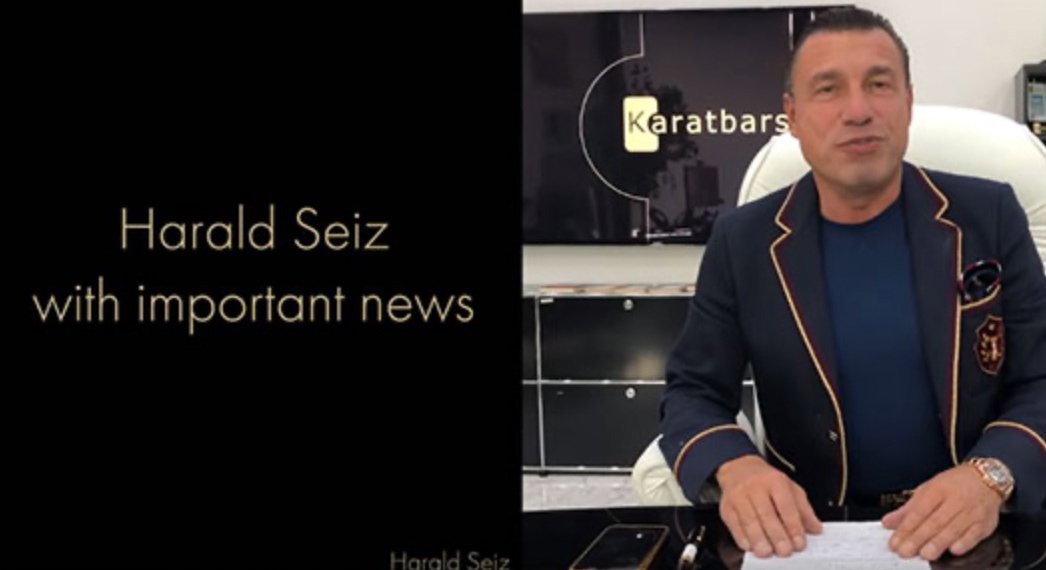
Freebay launched in June 2020 as a marketing reboot of Karatbars International, though the company presents itself publicly as a "partnership." Transparency remains limited regarding the actual ownership structure and the precise stake held by Karatbars owner Harald Seiz. Seiz, likely with undisclosed partners, appears to maintain ultimate control of Freebay, potentially through a network of shell companies designed to obscure financial flows and corporate beneficiaries.
Thomas Valet, Karatbars' Communications Manager, provided insight into the company's intentions during an August 31st corporate update call. Valet stated the company's "heart now gets a refreshment," announcing a "new sales company that will be launched, unencumbered, without negative comments, messages, campaigns or targeted misinformations." This "new sales company" is Freebay. Valet further described Freebay as located "in the center of Switzerland. Internationally untouchable, solid, surrounded by international companies, organizations and associations." This claim suggests an effort to insulate the operation from past regulatory scrutiny.
Karatbars International has faced significant regulatory actions and warnings from financial authorities globally in recent years. Countries including Germany, South Africa, Namibia, and Canada issued public warnings against Karatbars and its associated KaratGold Coin (KBC) cryptocurrency, often citing concerns related to pyramid schemes and unregistered financial products. The German Federal Financial Supervisory Authority (BaFin) notably ordered Karatbars to cease its operations in Germany. These actions highlight the context behind the stated desire for Freebay to operate "unencumbered."
Jurgen Pulvermuller leads Freebay as CEO. Before taking this role, Pulvermuller served as Karatbars' Head of Global Sales, joining the company around 2019. His prior experience includes promoting other multi-level marketing (MLM) ventures such as Neora, Filabe, and Visalus. Other Freebay executives, including Norbert Take and Marius Broening, also originated from Karatbars' sales department, reinforcing the direct lineage between the two entities.
Freebay offers no retailable products or services to the general public. Affiliates market only the Freebay affiliate membership itself. This membership grants access to a video library called "Freebay Academy," which covers topics like education and cryptocurrency trading. A nine-lesson "Trader Academy" module is also available. These internal educational materials serve as the primary "product" within the compensation structure.
Freebay's compensation plan requires affiliates to sign up for membership and invest in V999 tokens. Membership tiers include EVO Academy at €50 monthly or €480 annually, EVO Expert at €190 monthly or €1820 annually, and EVO Life at €480 monthly or €4600 annually. V999 token investments occur through an internal platform known as the "Genesis Market" exchange. Commissions are paid out for recruiting new Freebay affiliates and for their subsequent V999 token investments.
All V999 token investors receive a daily share equivalent to 0.02% of the funds invested through the company. A residual 0.02% bonus on V999 token investment extends down ten levels within a unilevel recruitment structure. An additional "Daily Investor Bonus" rewards the top ten biggest investors, ranked by transaction volume, with 0.01% of the company-wide investment volume each day. These guaranteed daily returns, funded by new investor money rather than external revenue, are a hallmark of a Ponzi scheme. The structure heavily relies on continuous recruitment and new investments to pay existing participants.
Freebay's compensation plan includes twelve affiliate ranks, each with specific qualification criteria typically tied to personal and downline investment volume and recruitment numbers. The first rank, One Star Sapphire, requires an initial Freebay registration. Without external retail sales generating revenue, the entire system depends on the influx of new capital from new participants. This model creates a pyramid structure where profits for early investors are paid by the funds from later investors.
The claim of being "internationally untouchable" from a Swiss base often accompanies schemes seeking to avoid regulatory oversight. While Switzerland offers a business-friendly environment, its financial regulators still monitor and take action against unregistered investment schemes and illicit financial activities, regardless of the claims made by promoters. Investors interested in cryptocurrency or trading education should seek platforms that derive revenue from genuine market activities or product sales, not solely from participant investments and recruitment.
 Harald Seiz