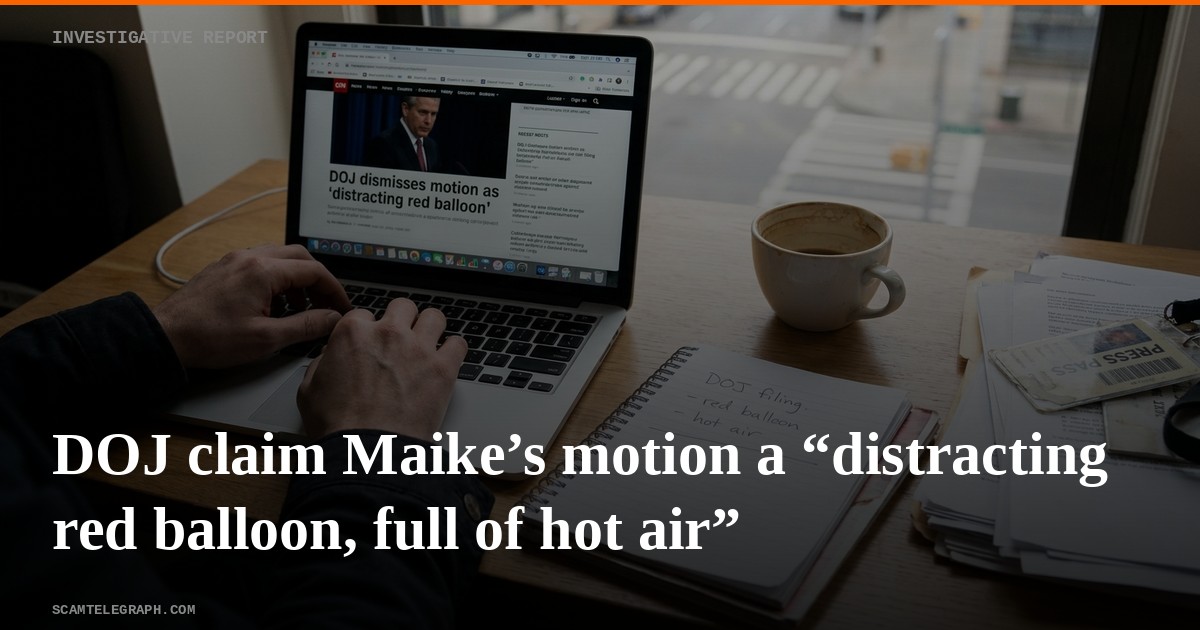
Richard Maike filed a motion to disqualify Assistant United States Attorney Marisa Ford on the same day he faced indictment. The Department of Justice quickly dismissed Maike's filing, labeling it a "distracting red balloon, full of hot air but devoid of any substance."
AUSA Ford had filed the criminal complaint against Maike in April. She also led the DOJ's intervention in Maike's civil defamation case against whistleblower Chuck King.
Maike's motion argued Ford breached the Ethical Standard for Prosecutors Act. He claimed she provided "legal assistance in any case in which the United States is a party or has a direct and substantial interest," referring to her involvement in King's defense.
The DOJ asserted Maike's "red balloon" motion "bursts under even the most gentle of probing." Prosecutors stated Ford did not engage in prohibited outside activities, nor did she represent a third party. They found no conflict of interest.
The core of the DOJ's involvement in the defamation case stemmed from concerns about King. King, representing himself, faced pressure to sign settlement documents containing "untrue statements." These statements, the DOJ feared, could compromise the government's criminal case against Maike.
On April 10, 2017, King informed the FBI that Maike's settlement proposal had expanded beyond initial terms. Maike, he said, was using the looming April 17, 2017 civil trial date to extract additional concessions. These included an Affidavit and a one million dollar Consent Judgment.
King told the FBI the statements drafted in Maike's proposed Affidavit were false. An FBI case agent relayed this information to AUSA Ford, who was assigned to the Maike criminal investigation.
Ford recognized that both the Affidavit and Consent Judgment could damage the integrity of the government's criminal case. King was a government witness. Pressuring him to sign false statements, or a Consent Judgment usable as impeachment material, presented a significant risk to the prosecution.
The DOJ contended this pattern of dishonesty extended into Maike's disqualification motion. The motion, prosecutors argued, contained several false statements itself.
Maike's filing claimed the parties had already agreed to civil settlement terms on Friday, April 7, 2017. He asserted King "agreed to sign an affidavit that stated his intention to destroy... Maike's company, Finance Ventures," but then "abruptly cut off communication" before signing.
But this claim directly contradicted an Order and Report filed by the United States Magistrate Judge regarding the settlement process. If a settlement had been finalized as Maike suggested, the court would likely not have conducted a lengthy settlement conference just three days later, on April 10, 2017.
The Department of Justice stressed that AUSA Ford's actions were limited to protecting the integrity of its criminal investigation, specifically by preventing a key witness from signing documents containing known falsehoods.
 Kimball Parker