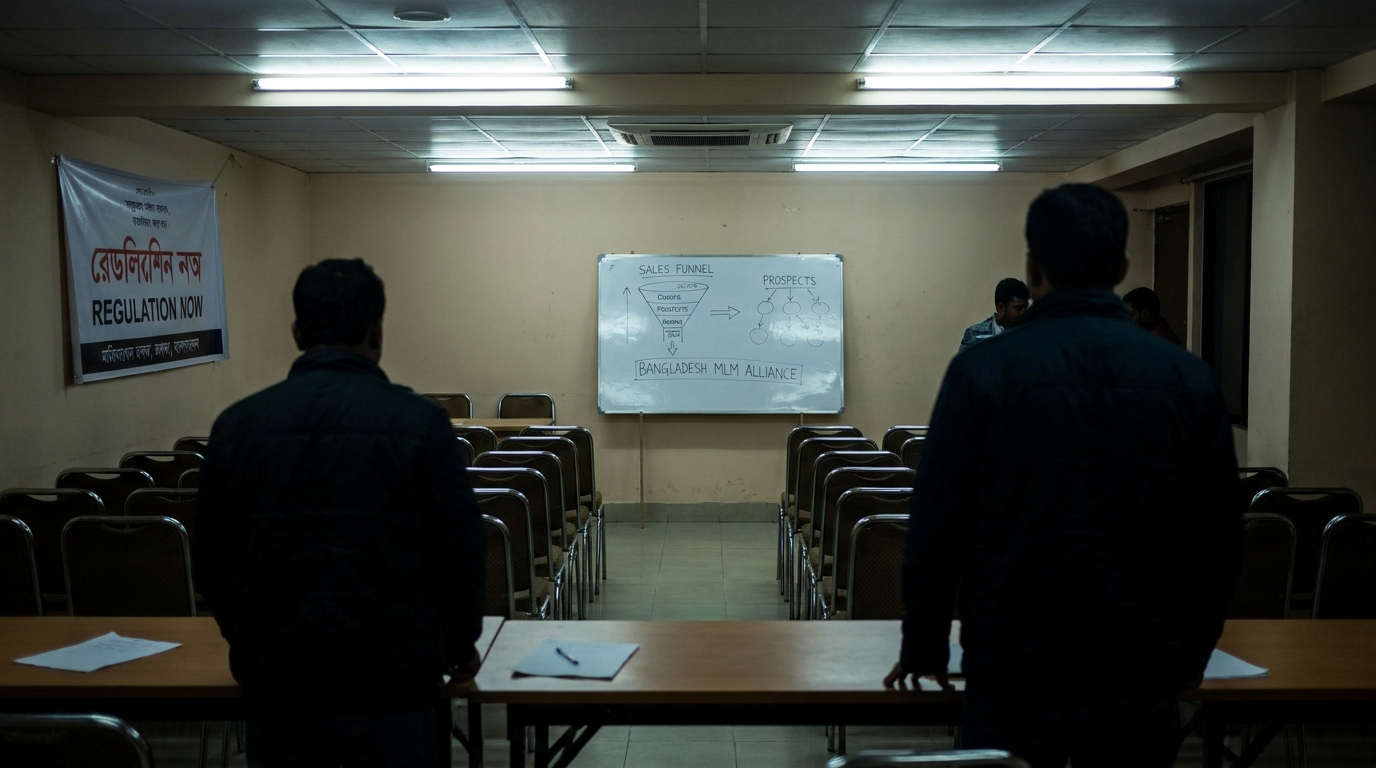
ScamTelegraph reports that a coalition of Bangladeshi multi-level marketing (MLM) companies has urged the government to implement regulations for the industry. This call comes amidst concerns that approximately 70 MLM firms operate in the country, with nearly two-thirds reportedly engaging in illegal banking activities, contributing to consumer financial ruin.
A significant challenge in combating fraudulent multi-level marketing schemes lies in the substantial time lag between their establishment and the commencement of regulatory investigations, often compounded by lengthy appeals processes. This delay allows illicit operations to extract considerable funds from unsuspecting individuals, leading to widespread financial distress before authorities can intervene effectively.
A group of MLM companies in Bangladesh has proactively sought to address this issue, appealing to the government for industry-wide regulation. According to the Joint Stock Companies and Firms registrar, around 70 MLM companies currently operate within the nation.
A concerning majority, nearly two-thirds of these companies, are reportedly involved in banking activities, which is illegal for MLM entities. The remaining firms offer a limited range of products, suggesting a reliance on recruitment rather than genuine product sales for revenue generation. This situation indicates that Bangladesh may be experiencing a surge in "get rich quick" MLM schemes, with regulatory oversight appearing slow to adapt.
Gazi Md Zakir Hossen, chief executive officer of Uptrend Distribution Ltd (known as uptrend2u), has specifically identified several companies as problematic. He pointed to Unipay2u, TVI Express, Visa Ray, Speak Asia, Legend Venture, Unigateway, Goldtrend, Neway, and Destiny-2000 Ltd. While TVI Express is recognized for its controversial practices, other companies mentioned appear to operate on similar recruitment-driven models, often lacking substantial products.
Frustrated by these companies tarnishing the reputation of the MLM industry in Bangladesh and eroding consumer confidence, a section of MLM companies held a press briefing. They requested government action against those involved in illegal banking under the guise of multi-level marketing. This group asserts that multi-level marketing fundamentally does not permit banking operations and must be product-based, where profit genuinely stems from selling goods or services.
The proactive stance by these Bangladeshi companies is notable, given that similar collective industry action against fraudulent schemes is less common in other regions. Without a tangible product, such operations essentially function as money transfer schemes, which can take regulators months, or even years, to effectively shut down. Legitimate MLM companies often express frustration over the market entry of fraudulent schemes with unsustainable compensation plans, which erode consumer trust and tarnish the industry's reputation.
Why did a group of Bangladeshi MLM companies call for regulation?
A coalition of Bangladeshi MLM companies has requested government regulation to address the significant delay between the establishment of fraudulent schemes and their investigation, which allows scams to cause widespread financial harm.
What is the primary concern regarding current MLM operations in Bangladesh?
The main concern is that approximately 70 MLM companies operate in the country, with nearly two-thirds allegedly involved in illegal banking, rather than genuine product sales, leading to financial exploitation.
Which companies were specifically named in connection with illegal practices?
Gazi Md Zakir Hossen, CEO of Uptrend Distribution Ltd, specifically named Unipay2u, TVI Express, Visa Ray, Speak Asia, Legend Venture, Unigateway, Goldtrend, Neway, and Destiny-2000 Ltd as companies engaged in questionable operations.
What do the advocating MLM companies believe constitutes legitimate MLM?
The companies advocating for regulation assert that legitimate multi-level marketing must be product-based, with profits derived from actual product sales, explicitly excluding banking activities.