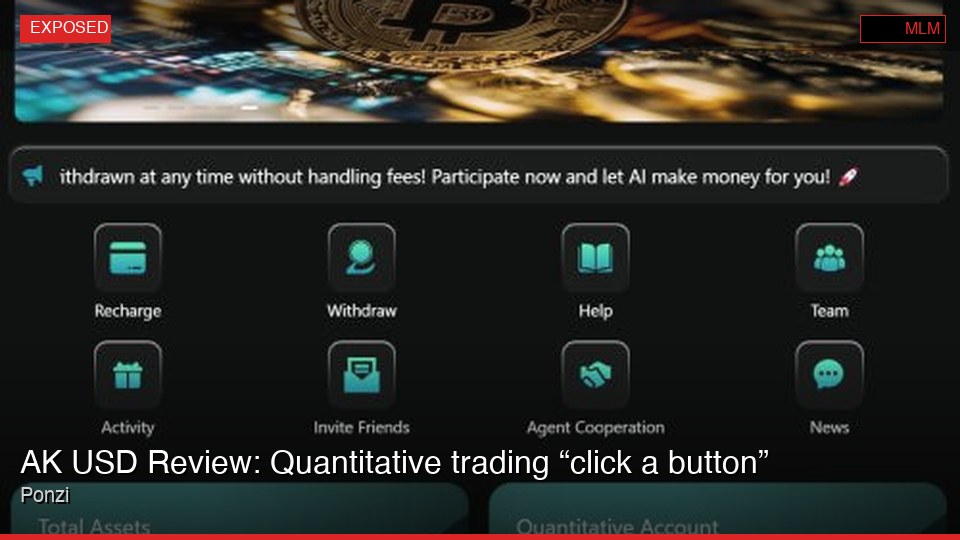
The AK USD website, akzuozhu-usd.com, was registered on January 22nd, 2025, through Alibaba (Singapore) using false registration details. This anonymous setup, common in fraudulent investment schemes, allowed the platform to operate without disclosing any ownership or executive information, a critical red flag for any legitimate financial entity. Its collapse on March 4, 2025, less than two months after registration, marked the end of another "click a button" cryptocurrency scheme.
AK USD offered no tangible product or service. Its business model relied solely on recruiting new affiliates who invested Tether (USDT). Participants enrolled in various "VIP" tiers, each requiring a different minimum USDT investment and promising daily returns. These advertised returns were exceptionally high, ranging from 13% to 33% per day, depending on the investment level. For example, a VIP1 investor depositing 10 USDT was promised 1.3 to 1.8 USDT daily, while a VIP10 investor with 33,333 USDT could expect 7,150 to 11,111 USDT daily. Such rates are unsustainable in any legitimate investment market.
The scheme also incorporated a multi-level referral commission structure. Affiliates earned 10% on direct recruits (level 1), 3% on level 2 recruits, and 2% on level 3 recruits. Membership itself was free, but participation in the investment program required a minimum 10 USDT deposit. This design incentivized continuous recruitment to fund payouts to earlier investors.
AK USD promoted itself with a cover story of "quantitative trading." Affiliates were instructed to log into an app daily and "click a button." The platform claimed these clicks activated quantitative trading algorithms that generated the advertised revenue, which AK USD then supposedly shared with investors. The more money invested, the more clicks required. No genuine quantitative trading platform operates by requiring users to manually click a button; this mechanism served only to give users a false sense of participation and control.
In reality, the button clicks did nothing. AK USD functioned as a classic Ponzi scheme, paying early investors with funds collected from new participants. The entire operation recycled newly invested capital. This model is mathematically guaranteed to collapse, as the inflow of new money inevitably dwindles.
AK USD belonged to a wave of "click a button" app Ponzis that emerged in late 2021. Previous examples employing the same "quantitative trading" ruse include QUA AI Bot, AI Profit USDT, and Bytesi. Hundreds of these schemes have been documented since 2021, most lasting only weeks or a few months before disappearing. These platforms typically vanish by simultaneously disabling their websites and apps, often without warning, leaving the majority of investors with significant losses.
Before a full collapse, investors frequently reported their accounts being locked after attempting to withdraw funds. Scammers often exploit this situation by initiating "recovery scams." They demand additional fees, claiming these payments will restore account access or enable withdrawals. Victims who pay these fees find withdrawals remain disabled, and the scammers cease communication.
Chinese organized crime groups operate these "click a button" Ponzi schemes from scam factories located in Southeast Asian countries. The US Department of Treasury sanctioned Cambodian politician Ly Yong Phat in September 2024 for his alleged ties to Chinese human trafficking scam factories. Phat's companies reportedly provided shelter and support to Chinese scammers operating from Cambodian territories.
Myanmar reported the deportation of over 50,000 Chinese scam factory workers since October 2023. Despite these efforts, "click a button" app scams continue to appear regularly. Chinese ministry representatives visited Thailand in late January 2025 to address organized Chinese crime gangs operating from Myanmar, highlighting the cross-border nature of these operations. The same network of Chinese scammers is believed to be behind the proliferation of these app Ponzis, regardless of their specific country of operation.
Victims of cryptocurrency investment fraud can report incidents to the FBI's Internet Crime Complaint Center (IC3).
 Ly Yong Phat