On August 19, 2020, the U.S. Department of Justice unsealed indictments against Renato Rodriguez and Gutemberg Dos Santos, alleging their involvement in AirBit Club, a purported cryptocurrency investment scheme. These charges marked a critical development for an operation that had promised daily returns on Bitcoin investments since its domain registration in September 2015.
The AirBit Club website offered no details about its ownership or management. The domain "bitbackoffice.com" was registered on September 27, 2015, using private registration services to obscure its true operators. Early claims circulated that Renato Rodriguez, known for his role in the ViziNova Ponzi scheme, was connected to AirBit Club. Independent verification was initially difficult for investigators.
By mid-May 2016, a Facebook post from AirBit Club Philippines named Gutemberg dos Santos as a co-founder. Dos Santos had co-founded ViziNova alongside Rodriguez. This confirmed the link between the two individuals and the new crypto venture. Days later, an undated photograph emerged, showing both Dos Santos and Rodriguez at what appeared to be an AirBit Club recruitment event. Rodriguez was actively working at computers, suggesting an executive function within the organization.
AirBit Club lacked any discernible retail products. Instead, its affiliates marketed AirBit Club memberships to other individuals, forming the sole basis of its operation. New affiliates paid a fee to join one of three tiers: Executive at $250, Corporate at $500, or Pro at $1000. Recruiters received an immediate 20% commission from these membership fees.
The scheme claimed that half of the membership fees went to Bitcoin mining operations, with the other half funding commission payouts. It promised daily returns ranging from 0.2% to 1.2% of the invested funds, with total payouts supposedly reaching up to 300 times the initial investment. The company stated that all mined Bitcoins were split among members and distributed accordingly. Such consistent, high daily returns are rarely achievable in genuine cryptocurrency mining, which faces fluctuating market conditions, high energy costs, and significant hardware investment. These claims often serve as a facade in Ponzi schemes to mask the flow of new investor money to earlier participants.
Payout durations varied by investment tier. Executive members received payouts for 150 days, Corporate for 225 days, and Pro for 300 days. Every 75 days, AirBit Club imposed a renewal fee equal to 35% of the ROI paid during that period, ensuring a continuous outflow of funds from members back to the scheme.
Beyond direct recruitment, AirBit Club structured its compensation through two complex mechanisms. A 3x18 matrix system paid $10 for each filled position. This structure allowed Executive affiliates to earn on three levels, Corporate affiliates on seven levels, and only Pro affiliates to access all eighteen levels, which could theoretically contain over 581 million positions. A binary structure also existed, assigning points to memberships. Executive memberships generated 200 points, Corporate 400, and Pro 900. Affiliates earned $20 for matching 200 points on both their left and right sides, with daily earning caps ranging from $500 for Executive to $10,000 for Pro members.
An optional "Retirement Plan" added another layer, requiring monthly payments of $150 to $350. This plan operated on a 3x32 matrix, offering payouts from $3 to $20 per filled position, depending on the level and the member's monthly fee. Overall, base affiliate membership cost $50 monthly, in addition to the initial package fee and any optional Retirement Plan expenses.
AirBit Club operated as an unregistered securities offering. The scheme promised passive returns on investment without registering with any securities regulator in the United States or other jurisdictions where it actively recruited. Under U.S. law, investments promising profit from the efforts of others, such as those made by AirBit Club, typically qualify as securities and require registration with the Securities and Exchange Commission (SEC). The lack of registration deprived investors of crucial disclosures and regulatory oversight.
Investigators determined AirBit Club functioned as a Ponzi scheme. While it may have conducted some token Bitcoin mining, its primary method of paying existing investors was through funds collected from new participants. This classic Ponzi structure relies on a constant influx of new money to sustain payouts, inevitably collapsing when recruitment slows. The elaborate matrix, binary, and retirement plan structures functioned as a pay-to-play pyramid scheme. Commissions tied directly to how much affiliates spent on memberships and monthly fees, rather than the sale of any legitimate retail products or services. This model violates consumer protection laws, which require MLM compensation to derive from actual product sales, not just recruitment fees.
The unusual Alexa data, which showed approximately 45% of AirBit Club's website traffic originating from South Korea despite most promotional materials being in Portuguese and Spanish, suggested targeted recruitment efforts in specific regions. This demographic targeting is common in fraudulent schemes seeking new, often less experienced, investor pools. When recruitment inevitably faltered, the financial inflows ceased, making commission payments impossible. The anonymous administrators often vanished, taking remaining investor funds with them.
Victims of such schemes often face severe financial hardship, losing life savings and retirement funds. Authorities advise individuals who suspect they have been defrauded to report the activity to the Federal Trade Commission (FTC), the SEC, and their local law enforcement agencies. The indictments against Rodriguez and Dos Santos highlight the legal consequences for orchestrating such widespread financial fraud.
 Renato Rodriguez
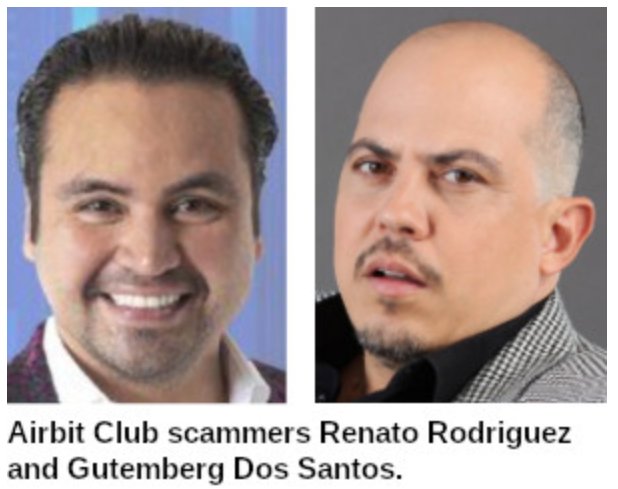 Gutemberg Dos Santos