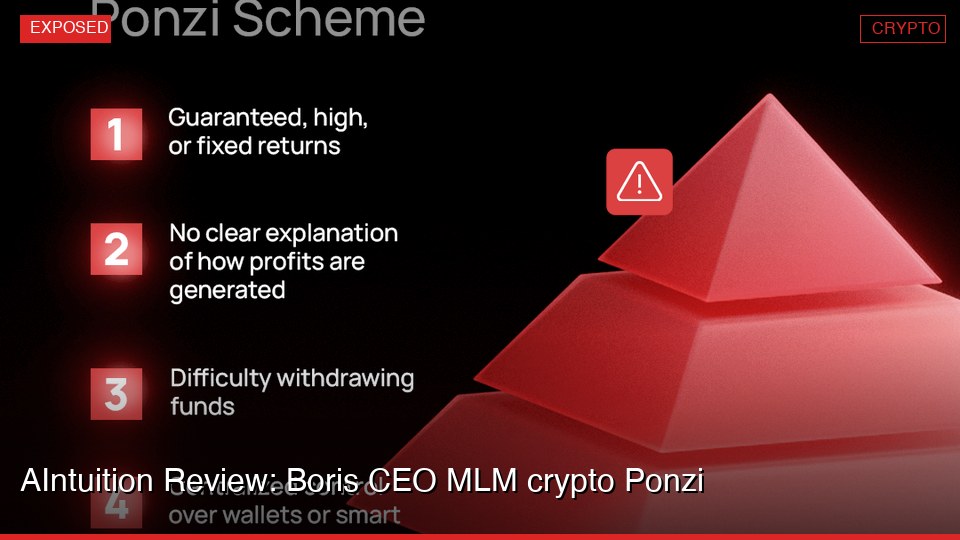
AIntuition, a cryptocurrency investment scheme that promised daily returns as high as 5%, collapsed on March 24th, 2026, leaving investors with significant losses and a worthless digital token. The operation, which masked its true operators, had initially launched with Russian-language marketing before pivoting to English-speaking audiences.
The aintuition.io domain was privately registered on April 1st, 2025, a common tactic used by fraudulent operations to obscure ownership details. Just over two months later, on June 11th, 2025, AIntuition uploaded its first YouTube video, featuring a masked individual identified as "Mr. Klaus" who spoke with an Eastern European accent, modified by a voice-changer. This initial push, primarily targeting Russian speakers, did not generate sufficient traction.
The company then introduced "German Vernons" as its supposed CEO on January 23rd, 2026, shifting its focus to English-language promotions. Vernons, however, appears to be an actor with a Spanish or Portuguese accent, existing only within AIntuition's promotional materials. This pattern of using hired actors to impersonate executives, often with Eastern European origins, is a known characteristic of "Boris CEO" schemes, which frequently originate from Russia, Ukraine, or Belarus.
AIntuition presented a Canadian company registration certificate for "Aintuition Limited" on its website. This document, easily obtained for shell companies with minimal scrutiny, offers no legitimate assurance of a company's financial health or regulatory compliance, particularly for multi-level marketing operations. Regulators often caution that such registrations are frequently exploited by scammers to create a false sense of legitimacy.
The scheme offered no retail products or services to external customers. Instead, its core business revolved solely around the sale of promoter memberships and investment packages. While AIntuition did offer ChatGPT guides ranging from $49 for a "Basic Course" to $249 for "Pro" expertise, these served primarily as token offerings rather than genuine revenue generators.
Promoters were required to invest tether (USDT) into various plans, with promised daily returns. These plans included "Starter Ridotto" offering 3% daily for 12 weekdays on investments of 10-50 USDT, and "Infinity Djack Pot," which promised 5% daily for 100 weekdays on investments up to 1,000,000 USDT, with the initial capital retained by AIntuition. Other tiers included "Novice Luck Starter" at 1.7% daily for 25 days, and "Supreme Infinity Vault" offering 4% daily for 70 days on investments up to 5,000,000 USDT.
The multi-level marketing component provided commissions for recruiting new investor-promoters. A seven-tier rank system, from "Follower" to "Founder," required increasing personal investment and downline investment volume. A "Founder," for example, needed to personally invest 50,000 USDT and generate 100,000,000 USDT in downline volume. Referral commissions were paid through a unilevel structure, extending up to thirty levels deep, with percentages varying by rank and level. A "Founder" earned 12% on direct referrals and 0.5% on levels 12-30.
AIntuition claimed its revenue came from an AI prediction model, supposedly developed by "Mr. Klaus," boasting a 99.3% accuracy rate. Such claims of exceptionally high, guaranteed returns with minimal risk are a hallmark of Ponzi schemes. No verifiable evidence ever emerged to support any external revenue generation from this alleged AI model or any other legitimate business activity.
The only discernible source of funds flowing into AIntuition was new investor money. This capital was then used to pay daily returns to earlier investors, a classic characteristic of a Ponzi scheme. When the recruitment of new promoters slowed, the influx of fresh investment capital dwindled. This inevitable decline in new funds meant AIntuition could no longer sustain its promised payouts.
Leading up to the collapse, a common warning sign for such schemes is the disabling of withdrawals, particularly for proprietary tokens. AIntuition had created its own BEP20 token, AINTU, which could be generated at negligible cost. When the scheme folded, most participants found themselves unable to cash out their investments and stuck holding a worthless digital asset. The math dictates that in a Ponzi scheme, the majority of participants ultimately lose their money.
 Boris
Boris