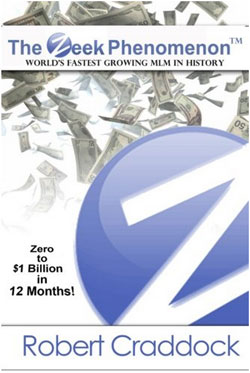
Robert Craddock, a figure previously involved with the Zeek Rewards scheme, published a new book, "The Zeek Phenomenon: Zero to $1 Billion in 12 Months," on Amazon September 29. The book's release comes years after Craddock's own activities related to the $850 million Ponzi scheme drew regulatory scrutiny.
Craddock was an investor in Zeek Rewards, a multilevel marketing company that operated from 2010 to 2012. He was later hired by Gregory Caldwell, a Zeek Rewards associate, to perform "compliance work." This role involved attempting to silence critics of the company. After the U.S. Securities and Exchange Commission (SEC) shut down Zeek Rewards in August 2012, labeling it an $850 million Ponzi scheme, Craddock became a vocal opponent of the agency's actions.
Following the shutdown, Craddock established ZTeamBiz, a network aimed at Zeek investors. Through this platform, he promoted various conspiracy theories regarding the SEC's intervention. He urged investors to send him thousands of dollars, claiming the funds would be used to fight the SEC and defend affiliates from regulatory action.
The initial promise was to protect all donors from SEC litigation. But as donations accumulated, the strategy shifted. Craddock began offering generic attorney letters at an additional cost to individual donors. Most of the collected money likely funded the legal defenses of Zeek "net winners" who operated ZTeamBiz. These individuals had profited from the scheme.
ZTeamBiz affiliates initiated several legal actions to prevent the recovery of funds they had acquired from other investors. All of these legal efforts failed. Craddock's name continued to surface in connection with questionable schemes until regulators and the Zeek Receivership finally shut down his operations in late 2013. A series of "Ponzi points" schemes he promoted subsequently failed. Craddock has now rebranded himself as a publisher.
His latest publishing project, "The Zeek Phenomenon: Zero to $1 Billion in 12 Months," appeared on Amazon through Ebon Research Systems Publishing. The 276-page book was listed as "out of print, limited liability" within a week of its September 29 launch, with no price specified.
The book's description promotes Zeek Rewards as "the fastest growing MLM company in the world" and praises its founders, despite acknowledging they "had no idea what they were developing." It suggests that banks closing Zeek's accounts due to large deposits were acting on "unsubstantiated impression[s]." The blurb goes on to portray Zeek as a potential blueprint for government stimulus programs. It alleges that "lawyers, doctors, lawmakers, teachers, and everyday people" united to question U.S. Government motives after the company's shutdown.
The book claims that when the U.S. Government closed Zeek Rewards, the company held "over 600 million dollars in the bank ready to pay out to the people who helped the Program grow!" It then asks, "Why would the US Government want to shut down the American spirit, innovation, self-reliance and global trade?" This narrative contradicts the documented financial realities of the Ponzi scheme.
Zeek Rewards did take in approximately $600 million between 2011 and 2012. However, the amount available when the SEC intervened was substantially less. The SEC's complaint, filed in the U.S. District Court for the Western District of North Carolina, revealed that Zeek held approximately $225 million in investor funds across 15 financial institutions. These funds were described as "at risk of imminent dissipation and depletion."
Affiliates had accumulated roughly $3 billion in "Ponzi points," a fictional currency within the scheme. At a 1:1 conversion rate, Zeek owed approximately $45 million per day to meet its obligations. With only $225 million in its accounts and no new investment, the scheme would have collapsed within about five days. This timeframe fell far short of the required 90-day return-on-investment maturity period promised to investors.
By July 2012, just one month before the SEC shutdown, Zeek's incoming revenue of approximately $162 million was nearly matched by its total investor cash payouts, which stood at about $160 million. The scheme was on the verge of implosion under its own weight. The SEC's intervention prevented a more complete collapse and protected remaining assets for victims.
The fundamental reality is that Zeek Rewards was a Ponzi scheme. Its owner, Paul Burks, made daily decisions on how much newly invested money to disburse to existing investors, rather than generating returns from genuine business activity. Burks, along with Dawn Wright-Olivares, his second-in-command, consented to a $600 million judgment payable to the Zeek Receivership. Wright-Olivares pleaded guilty to securities fraud and wire and tax fraud conspiracy, each charge carrying potential fines of $250,000 and up to five years in prison. The first round of restitution checks to victims of the Zeek Rewards scheme began distribution just weeks before Craddock's book appeared on Amazon.
 Robert Craddock