The 9M AI investment platform offered no verifiable ownership or executive information from its launch in April 2025. Both of its operational domains, 9mc.ai and 9mc.org, were registered privately on April 25, 2025, concealing the identities of the operators. Analysis of the application's source code revealed Chinese characters, suggesting a China-based origin for the scheme.
The platform lacked any retail products or services. Its business model relied solely on affiliates recruiting new investors into the system. Participants invested Tether (USDT), a stablecoin, or a mix of USDT with Mountain Protocol (USDM), promising daily passive returns. These returns varied based on lock-up periods, ranging from 1% daily for a 7-day commitment to 2% daily for a 360-day investment. The minimum investment amount was not publicly disclosed.
A multi-level marketing (MLM) structure incentivized recruitment. The scheme featured nine VIP ranks, each requiring specific downline investment volumes and the successful promotion of two affiliates to the preceding rank. For example, VIP1 status required 3,000 USDT in downline investment, while VIP9 demanded 30,000,000 USDT and two VIP8-ranked affiliates. Direct commissions paid 10% on level 1 recruits and 5% on level 2. Additionally, affiliates received a percentage match of their downline's daily returns, capped by their own personal investment, scaling from a 20% match for VIP1 to a 100% match for VIP9.
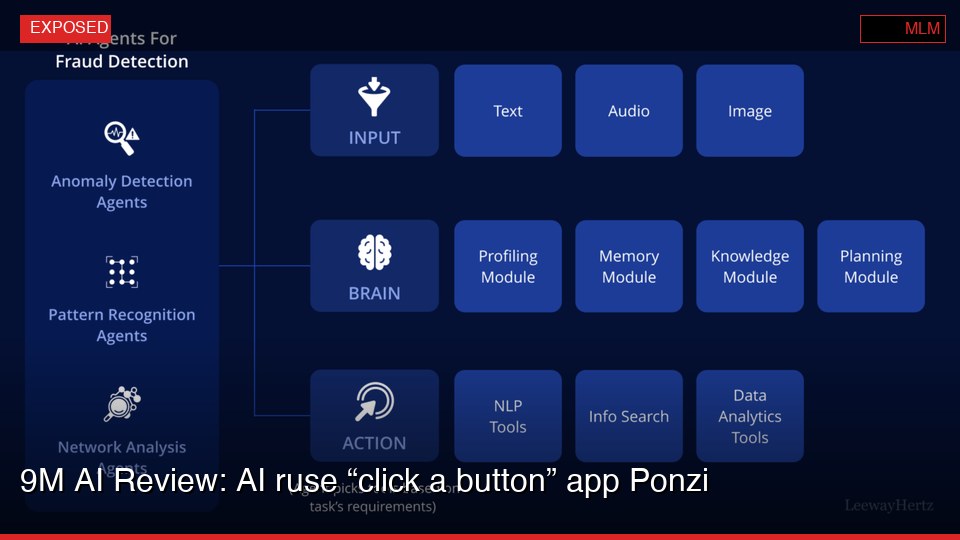
9M AI presented itself as a sophisticated artificial intelligence venture. It claimed to operate "NovaMind," a proprietary AI engine trained on "Financial LLMs" and real-world financial data. The company asserted that this system powered "the first AI-led asset management system," where the AI autonomously executed trades without human assistance. Investors were told they simply needed to log in, click a button, and the AI would generate profits, which 9M AI then shared.
These claims were false. The "click a button" mechanism in the app generated no actual revenue. The platform functioned as a Ponzi scheme, using funds from new investors to pay supposed returns to earlier participants. The scheme ultimately collapsed on August 19, 2025, with its app domain disabled, though the marketing site remained online. By October 11, 2025, the app had been moved to the marketing domain, and the operators began specifically targeting investors in South Korea.
9M AI is one of hundreds of "click a button" app Ponzis tracked since 2021, sharing mechanics with schemes like 365 AI, HHG Staking, and Aifeex. These operations typically collapse within weeks or months. When a collapse occurs, the websites and apps vanish without warning, accounts are locked, and withdrawal requests are ignored or met with demands for additional fees that victims never recover. Some operators then launch "recovery scams," demanding payments to unlock funds, a promise they never fulfill.
Organized Chinese crime syndicates often operate these scams from Southeast Asia. Scam factories in Cambodia, Myanmar, and Laos churn out these app Ponzis on an industrial scale. In September 2024, the U.S. Treasury sanctioned Cambodian politician Ly Yong Phat for providing shelter to Chinese scammers within his compounds. Myanmar reported the deportation of over 50,000 Chinese scam factory workers since October 2023, yet new "click a button" apps continue to appear.
Chinese officials visited Thailand in January 2025 to discuss organized crime operations originating from Myanmar. By early February, Thai authorities, in cooperation with China, cut power, internet, and fuel to scam factories along the Thai-Myanmar border. These actions reportedly led to the liberation of 10,000 trafficked hostages by February 20. The same day, authorities in the Philippines arrested five Chinese crime bosses and 450 others. Despite these crackdowns, reports on March 19 claimed up to 100,000 people still worked in Myanmar scam factories. By April 2025, the intensified enforcement pushed some operations into new territories, including Nigeria, Angola, and Brazil.
The Myawaddy region of Myanmar, situated along the Thai border, remains a key operational base. It is controlled by the Karen National Army (KNA) and its warlord, Chit Thu, along with his sons, Saw Htoo Eh Moo and Saw Chit Chit. This group protects and profits from the Chinese scam operations there. On May 5, 2025, the U.S. sanctioned Chit Thu, freezing his U.S. assets and prohibiting American entities from conducting business with him or his sons. Britain and the European Union had already imposed similar sanctions. A May 25 report characterized Myanmar and Laos as having "towering scam economies," but identified Cambodia as the primary hotspot for these fraudulent activities. Amnesty International, in June 2025, accused the Cambodian government of "deliberately ignoring" abuses, identifying 53 confirmed scam centers and dozens of suspected sites, including within Phnom Penh. Victims, some of them children, are trafficked into guarded compounds and forced to perpetrate scams, facing punishments such as electric shocks, beatings, and solitary confinement.
 Ly Yong Phat
 Donald Trump