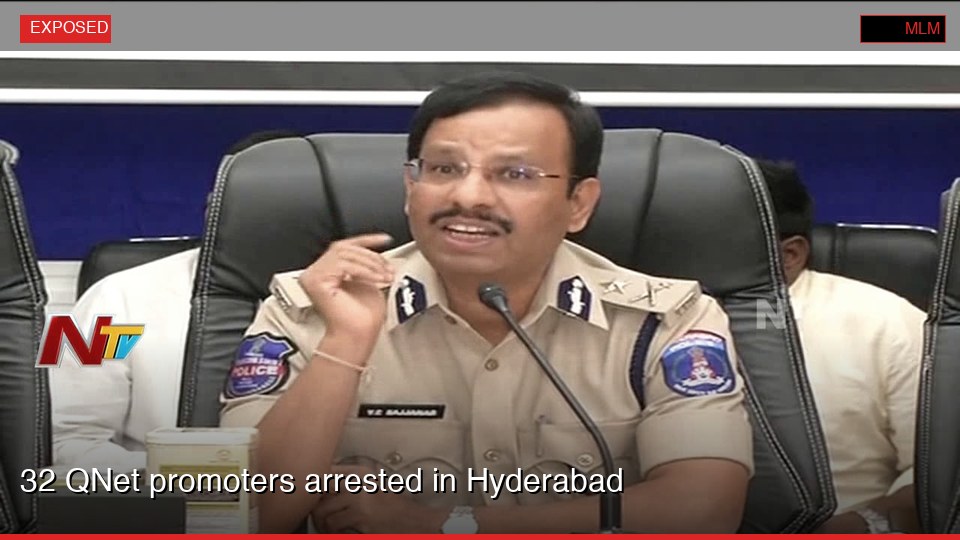
Thirty-two promoters for the QNet pyramid scheme were arrested in Hyderabad this week, marking another chapter in the company's decade-long evasion of Indian law enforcement. The arrests occurred on Monday, March 23rd, following coordinated raids across Telangana, Andhra Pradesh, and Karnataka states.
The investigation primarily targeted Vihaan Direct Selling Ltd., the entity QNet uses in India to present itself as a legitimate direct selling operation. Police Commissioner VC Sajjanar of Hyderabad stated that the accused initially concealed their ties to QNet's multi-level marketing model. They presented product sales as their front, but their true activity involved promoting an illegal money circulation scheme. This scheme promised substantial commissions and income for recruiting new members into the network.
Authorities specifically noted QNet promoters were targeting individuals from lower-income groups, a common strategy for such fraudulent schemes. These operations typically rely on continuous recruitment to sustain payouts to earlier participants, rather than genuine product sales.
QNet, its Indian subsidiary Vihaan Direct Selling India, and founder Vijay Eswaran have engaged in a prolonged struggle with Indian authorities. Vijay Eswaran, a Malaysian national, remains a wanted fugitive by Indian law enforcement, consistently avoiding apprehension.
Indian authorities first moved against QNet in 2013. The Enforcement Directorate froze multiple bank accounts linked to the operation, targeting funds suspected of originating from the illicit scheme. A year later, in 2014, a court order formally prohibited Vihaan Direct Selling from conducting business in India. Despite these legal directives, the company continued its activities, often shifting tactics to circumvent enforcement.
The legal actions intensified in 2016. The Delhi Enforcement Directorate registered its first criminal complaint against QNet and Vihaan Direct Selling. That same year, Michael Ferreira, a majority shareholder in Vihaan Direct Selling India, was arrested.
The alleged fraud has taken a significant toll on victims across India. In 2018, seventy victims staged protests in Bengaluru, demanding more effective regulatory action. A year later, in 2019, an Indian QNet victim died by suicide after losing $28,900 to the scheme. That same year, an investigation into commissions owed to an estimated 200,000 QNet promoters uncovered elements of government corruption and raised concerns about national security.
The Cyberabad Enforcement Directorate summoned over 500 individuals in 2019, including several Indian celebrities, to provide explanations for their public endorsements of QNet. Also in 2019, the Union Ministry of Corporate Affairs took decisive action, ordering the shutdown of Vihaan Direct Selling India's operations. Separately, the Odisha Enforcement Directorate arrested three QNet promoters.
The financial impact of QNet's alleged money laundering in India became more apparent in 2023. In January, authorities froze $11 million tied to the company's operations. Another $16 million linked to QNet was frozen in March as part of a criminal case in Hyderabad. Subsequent arrests included three QNet executives in Hyderabad in May 2023 and eighteen QNet scammers in Jaipur in October 2023. The Manipur QNet Victim's Welfare Association publicly called for stronger government action against the company in that same month.
A new criminal case against QNet was opened in Indore in September 2024. India's Central Consumer Protection Authority issued a public fraud warning regarding QNet in December 2024, advising consumers of the risks.
Despite consistent enforcement efforts, including arrests, asset freezes, and official warnings, QNet's online presence remains significant. As of February 2026, QNet's website recorded approximately 153,000 monthly visits, with India accounting for 21% of the traffic, followed by Thailand at 14%, and the United States at 5%.
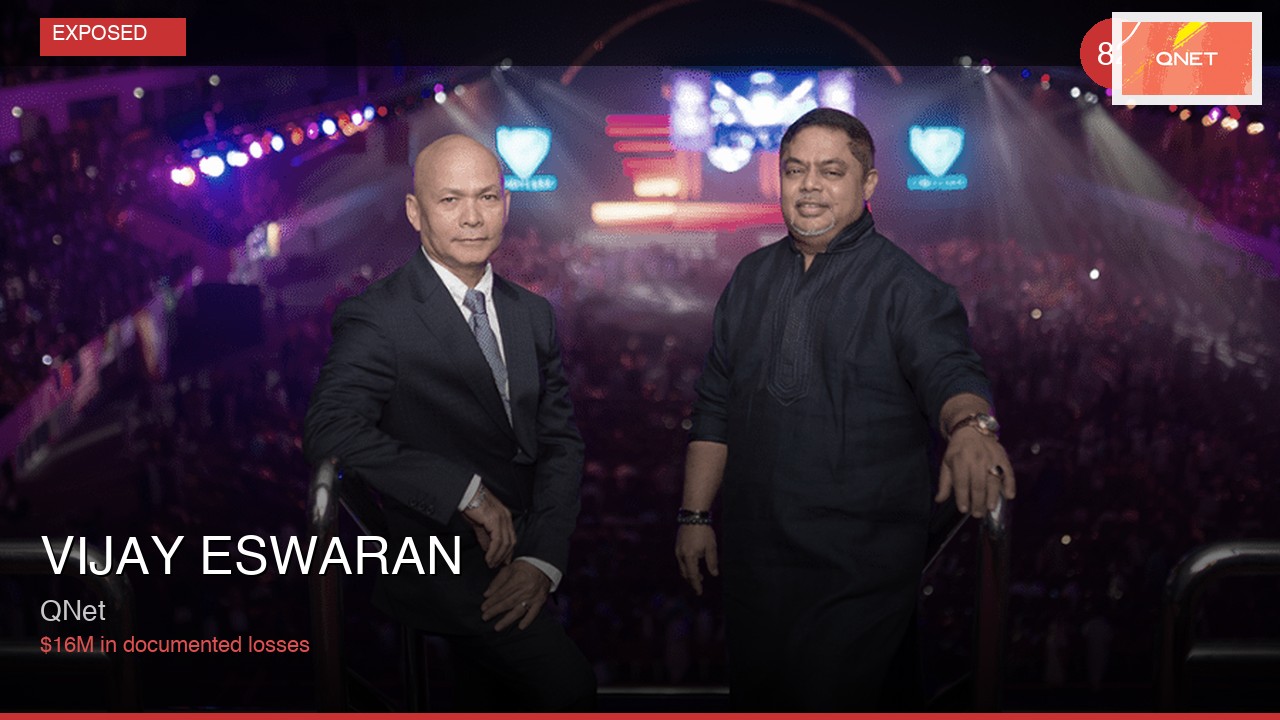 Vijay Eswaran