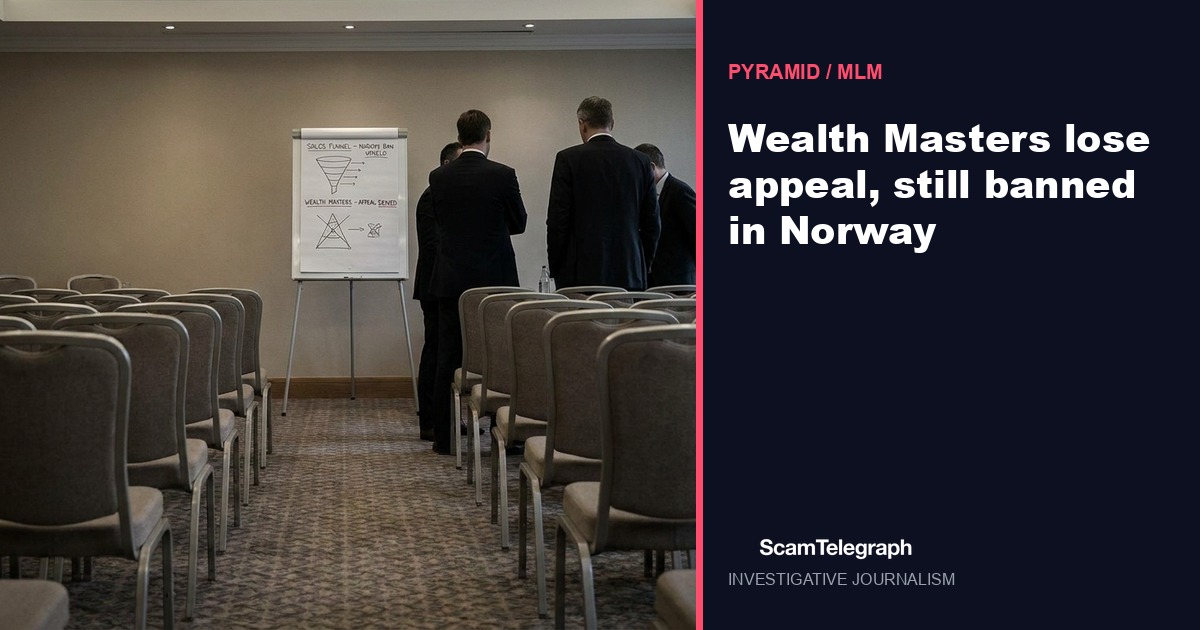
In March 2011, the Norwegian Gaming Board ruled Wealth Masters International operated as a pyramid scheme. The Board reached this conclusion after investigating the company's business model and products.
Wealth Masters appealed the decision. They accused the Gaming Board of "colluding with a Norwegian blogger" to "smear, libel and discredit WMI."
The Gaming Board reviewed the appeal but found no reason to change its original decision. In July 2011, it forwarded Wealth Master's appeal and complaints to the Lottery Board for further consideration.
By September, Wealth Masters had replaced its previous lawyers, Helleroy and Co., with Prashant Rørvik. Rørvik's team submitted additional information to the Lottery Board, aiming to clarify their complaints against the Gaming Board's ruling.
Through its lawyers, Wealth Masters argued several points. They claimed the company paid no compensation for recruiting new members. The company also stated its products were not overpriced, citing "considerable costs to hold courses." Wealth Masters insisted there was no annual fee for participation; instead, "each participant is free to participate regardless of payment in the form of annual fees." Finally, they asserted that Section 16 of Norway's Lottery Act, which the Gaming Board used for its assessment, "may not apply to WMI's business."
The Lottery Board acknowledged that determining pyramid schemes can be difficult. It noted the challenge in distinguishing between organizations aiming for healthy business with sales and services versus those focused on future profit from payments at the bottom of a pyramid.
But the Board reasoned that the Gaming Authority had made a "thorough assessment of WMI." It found Wealth Masters' turnover built over levels, forming a pyramid-like sales structure. Consultants received financial benefits across up to five levels, depending on their status.
The Lottery Board concluded that participant payment was a condition for the Lottery Act to apply to WMI. This meant WMI participants had to make a payment to gain participant status. The Board found the consideration for starter kits, brochures, introductory material, and educational courses did not match their actual values. This constituted an indirect acquisition of participant status within the system. The Lottery Board ultimately agreed with the audit: WMI's products had considerably lower value than their selling price, providing indirect compensation through overpriced goods, regardless of any voluntary yearly fee.
The Lottery Board's decision effectively upheld the Gaming Board's original declaration, maintaining the ban on Wealth Masters International in Norway.
 Faith Sloan