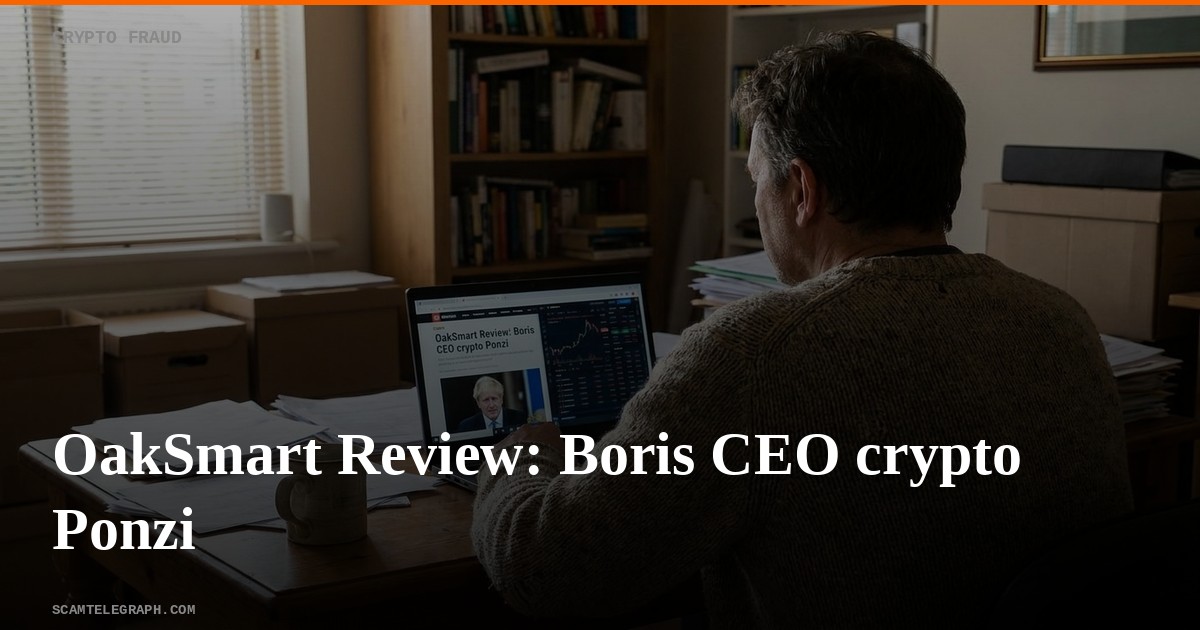
California regulators issued a securities fraud desist and refrain order against OakSmart on December 2nd, 2024, targeting what authorities describe as a cryptocurrency Ponzi scheme. The Department of Financial Protection and Innovation (DFPI) accused OakSmart of operating without proper authorization and defrauding investors, particularly in the United States. The operation uses two primary websites, oaksmart.com, registered in 2017, and oaksmart.pro, added on September 13th, 2024. Neither site provides any public information about its owners, executives, or physical location.
OakSmart claims to hold a Money Services Business (MSB) license through the Financial Crimes Enforcement Network (FinCEN). This registration does not constitute a financial license or regulatory oversight. FinCEN primarily focuses on anti-money laundering and counter-terrorism financing; it does not vet the legitimacy of investment schemes or protect consumers from fraud. Scammers frequently exploit MSB registration to create a false impression of regulatory compliance. The OakSmart websites also feature a video titled "CEO's speech," but the speaker remains unnamed throughout the presentation.
Early promotional videos on platforms like YouTube used generic stock footage with voiceovers. By June 2024, OakSmart began posting recordings of Zoom calls that included individuals with Russian names. A key figure, calling himself "TR" or Tristan, emerged as the operation's chief marketing officer. Tristan made his first solo video appearance on October 8th.
Before his involvement with OakSmart, Tristan was associated with Cestar College – Syn Studio in Montreal. He relocated to Thailand around 2019, settling in Chiang Mai. During his time there, he spent time at a wellness retreat, where he posted a testimonial about seeking purpose. Post-2019, he began fronting various questionable multi-level marketing investment schemes.
Investigators examining the OakSmart website's source code discovered Chinese language elements. This, combined with the presence of Russian names in marketing materials and Tristan's base in Thailand, suggests the scheme is operated by individuals of Russian and Chinese origin. Thailand has seen a notable increase in its Russian population in recent years. The Chinese operators are likely working from neighboring Vietnam.
Website traffic data corroborates these geographical links. As of October 2024, analytics from SimilarWeb show Vietnam accounted for 76 percent of OakSmart's website traffic, with the United States making up 24 percent. Despite a substantial US investor base, OakSmart has no legitimate corporate presence or operational ties within the country.
The OakSmart scheme itself lacks any tangible products or services. Its business model relies solely on affiliates recruiting new members. New investors are encouraged to deposit cryptocurrency with the promise of passive returns. These returns are not generated from any legitimate commercial activity. Instead, funds from new investors are used to pay off earlier investors, a defining characteristic of a Ponzi scheme. Such operations inevitably collapse when the influx of new money slows, leaving most participants, especially those who joined later, with significant losses.
The DFPI's order against OakSmart underscores the risks associated with opaque investment opportunities. Investors should exercise extreme caution with any company that conceals its ownership or leadership. Funds sent to such schemes, particularly across international borders and in cryptocurrency, are often impossible to recover.
 Boris
Boris