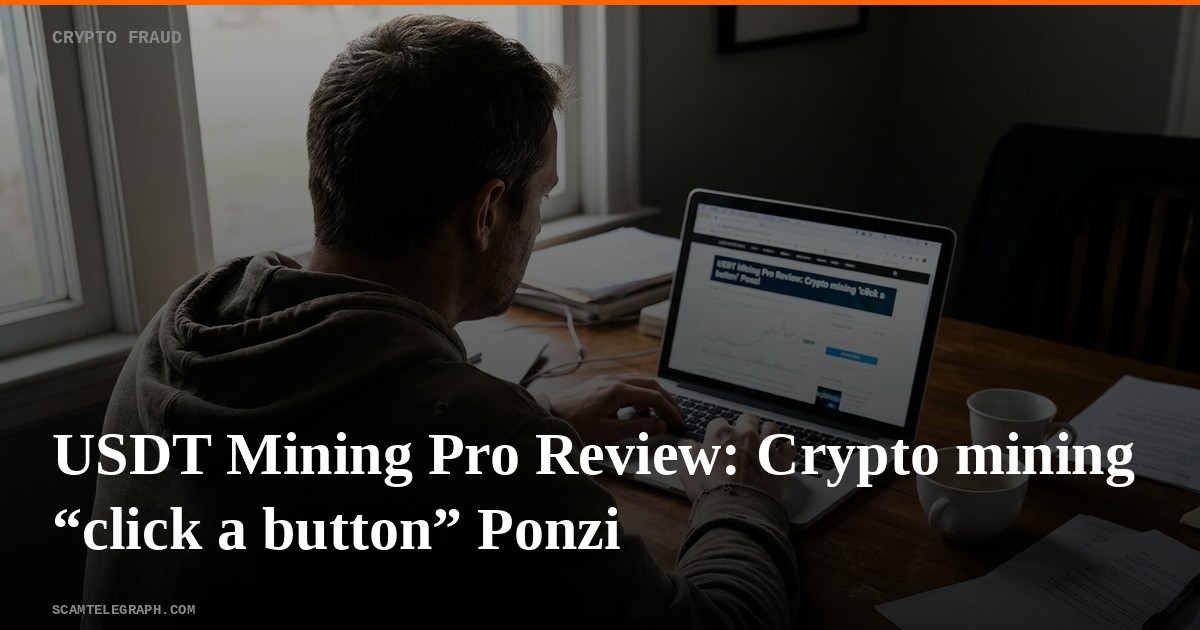
USDT Mining Pro operates a cryptocurrency investment platform promising daily returns up to 16%, despite its domain "pos.tx111.club" showing a private registration date of April 28, 2025. The company provides no information about its ownership, executives, or corporate registration on its website.
The platform offers no tangible products or services for retail customers. Affiliates recruit new members, marketing the USDT Mining Pro membership itself as the primary offering.
Investors fund accounts with Tether (USDT), expecting daily returns based on a tiered system. VIP1 members deposit 10 to 499 USDT for a 4.2% daily return. Investments escalate through VIP tiers, reaching VIP6, where 200,000 USDT or more supposedly yield 16% daily. For example, a VIP3 investment between 5,000 and 19,999 USDT promises a 7.9% daily payout.
The compensation plan extends beyond direct returns. USDT Mining Pro pays an 8% matching bonus on the daily returns of recruited members, spanning two levels of its unilevel recruitment structure. Joining costs nothing. But full participation in the income opportunity requires a minimum 10 USDT investment.
USDT Mining Pro presents itself as crypto mining. Affiliates are instructed to log in daily and click a button to initiate mining. This premise lacks logical coherence. If the company already maintains mining infrastructure, it would not need external capital from individual investors.
In reality, the daily button click performs no actual mining function. USDT Mining Pro operates as a Ponzi scheme. It relies on funds from new investors to pay out earlier participants. This model is unsustainable.
The scheme fits a pattern of "click a button" app Ponzis that began appearing in late 2021. Previous examples, such as TronSoy, Mining Memes, and Tron CFD, used similar cloud mining pretenses before collapsing. ScamTelegraph has documented hundreds of these schemes since 2021. Most last only a few weeks to a few months.
Collapse typically occurs without warning. The platforms disable both their websites and mobile applications, leaving most investors with significant losses. Before the final shutdown, investors often find their accounts locked, particularly when attempting to withdraw funds.
Scammers frequently follow up these collapses with "recovery scams." They demand additional fees from victims, claiming this will unlock funds or re-enable withdrawals. Payments made during these recovery attempts rarely result in funds being returned, and the scammers cease communication. Organized criminal groups, primarily from China, operate these scam factories from locations in Southeast Asia.
Victims of such schemes can report to the FBI's Internet Crime Complaint Center (IC3) at ic3.gov.
 Boris
Boris