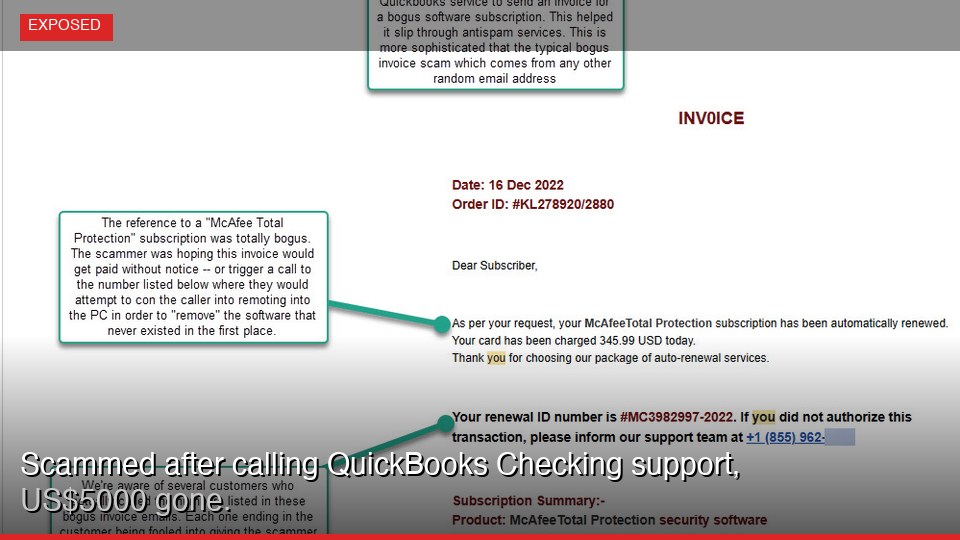
A QuickBooks Support Call Cost One Business Owner $5,000
A fraudster posing as QuickBooks support walked away with $5,000 from a business owner's account in a carefully orchestrated scam that exploited the company's own customer service channels.
The victim had operated a business checking account with QuickBooks for three years without incident. Two weeks ago, he couldn't locate his 1099-INT tax form online. The QuickBooks chatbot directed him to call support and provided a phone number.
After an hour on the phone—transferred five times between offshore support representatives—a rep offered to escalate the case. Then he made his move.
The rep claimed he spotted a different phone number on file and asked to call it to verify the account owner's identity. The victim had never shared his company phone number during the conversation. Ten seconds later, a call came through on that line from what appeared to be the same rep, displaying matching caller ID information.
The scammer told him a verification code would arrive to authorize account access. The victim hesitated but provided it anyway.
While pretending to document the escalation, the rep asked a crucial follow-up question: did he have his debit card handy? Could he share the last four digits for a security check?
Red flags exploded in the victim's mind. He refused and hung up.
Moments later, he refreshed his account and saw the damage. Someone had transferred $5,000 to an unknown card ending in 5903 and charged a $75 instant transfer fee. No email alert. No text notification. No warning—despite the account being set to notify him of every withdrawal and deposit. Whoever made the transfer had apparently suppressed those notifications from inside the system.
The victim filed a police report and sent a dispute to Green Dot Bank, the financial institution behind QuickBooks' checking accounts. Green Dot's Ohio mailbox received his documentation on Friday.
They rejected his claim on Monday. No email explanation. No letter detailing their reasoning.
He remains out $5,075 with little recourse. What made this scam particularly ruthless was its sophistication. The fraudster didn't need to spoof a number—he already had account access. He used QuickBooks' own support system to gain the victim's trust, then extracted payment authorization details before attempting the final theft.
The victim says he's typically cautious about security. This time, the scammer's advantage was paralyzing: the phone number came directly from QuickBooks' official chatbot.
🔗 Related Articles
- Eddy Alexandre tries to weasel out of EminiFX bail conditions
- iGenius fraud charges filed against Gamechangers Polska
- USFIA Receiver recovers $20.4 million
- TelexFree exit strategy thwarted, millions recovered
- Truvy Review: No retail customer differentiation