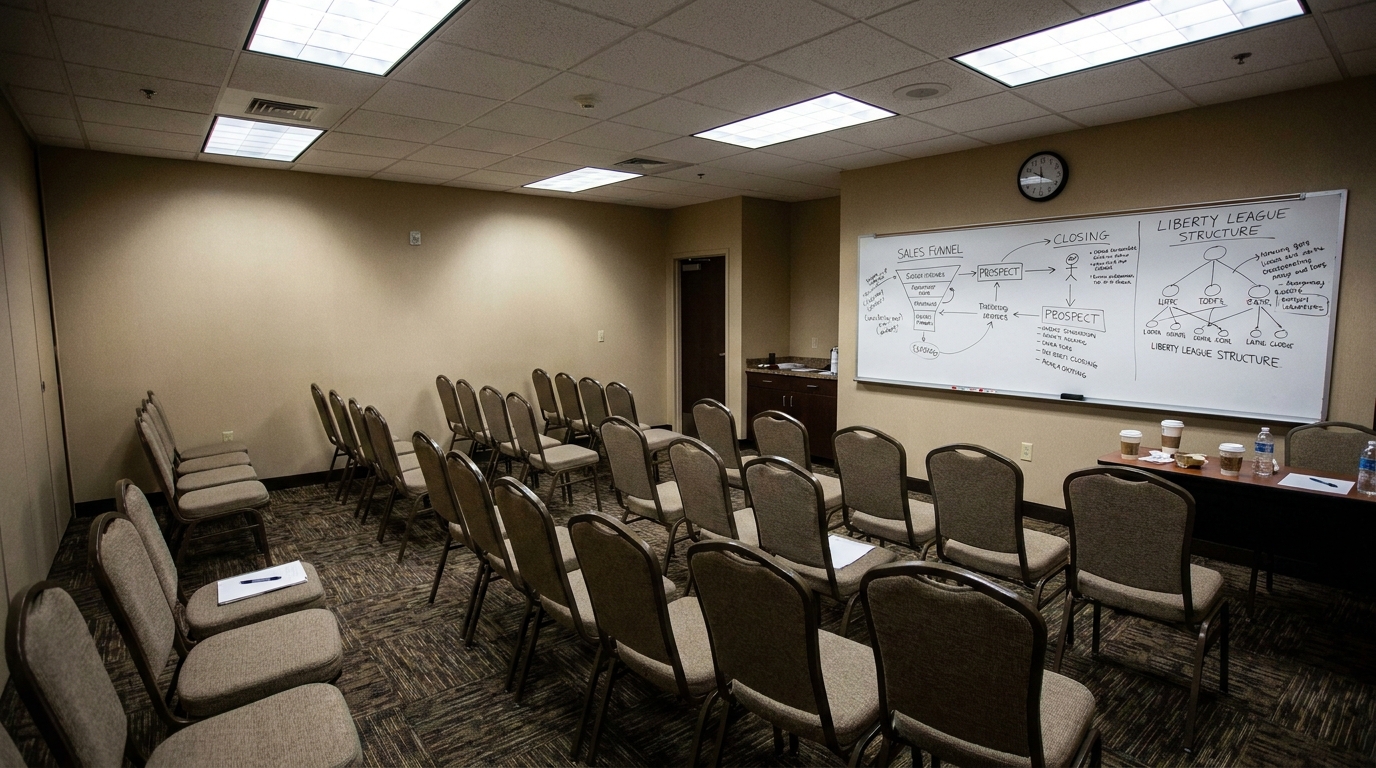
The NSW Office of Fair Trading has publicly flagged Liberty League as a suspected pyramid scheme, yet Polaris Media Group is instructing its distributors to disregard this official government warning. ScamTelegraph notes this advice came via an internal forum, prompting associates to tell prospects to cease asking questions about the scheme’s legitimacy.
The directive from Polaris Media Group emerged after an associate posted on the company's internal network, seeking guidance on how to address prospects who had conducted their own research into Liberty League. The responses from within the company's ranks revealed a strategy to dismiss external scrutiny and maintain recruitment efforts.
One line of reasoning presented by an associate questioned the very authority of the NSW government warning. This argument asserted that a .gov.au website designation did not inherently signify relevance regarding governmental operations or its findings on fraud. This position disregards the role of the state government in defining and enforcing laws against illegal schemes within Australia.
Another argument put forth was the "durability defense," suggesting that Liberty League's alleged nine years of operation and "massive growth" somehow validated its business model against claims of being a pyramid scheme. Such a defense implies that the longevity of an operation, even if it is illegal, somehow legitimizes it, which is contrary to legal principles regarding illicit activities.
The most concerning aspect of Polaris Media Group's internal guidance is the active encouragement for associates to tell prospective participants to ignore official government information and cease independent investigation. This advice effectively instructs distributors to shut down inquiry and continue selling, rather than offering transparency or a substantive explanation to address the regulatory warning.
This operational approach suggests a continuity from Liberty League to Polaris Media Group. Liberty League reportedly operated for several years until its top earners exhausted their downlines, rendering the model unsustainable. The company subsequently rebranded as Polaris Media Group, continuing to promote what appears to be the same structural model to a new audience.
Pyramid schemes inherently rely on an ever-increasing influx of new recruits whose payments primarily benefit those at higher levels of the structure, rather than genuine sales of products or services. When the supply of new participants diminishes, the scheme inevitably collapses. Liberty League's reported years of growth, therefore, do not negate the fundamental mathematical flaws of such a model; rather, they may indicate the exhaustion of one market segment and the subsequent need for rebranding to access new ones.
The denial emanating from Polaris Media Group regarding the government's findings appears to be a strategy for operational continuity. However, the company's instruction to its distributors to disregard official warnings and discourage critical inquiry from prospects provides insight into the nature of the business model being defended. When the primary response to government alerts and participant questions is to dismiss them, the integrity of the operation itself comes under significant scrutiny.
What is the core issue with Polaris Media Group's recent advice?
Polaris Media Group advised its distributors to ignore an official warning from the NSW Office of Fair Trading that classified Liberty League as a suspected pyramid scheme. This internal guidance also encouraged associates to tell prospects to stop asking questions about the scheme.
How did Polaris Media Group associates justify ignoring regulatory warnings?
Associates questioned the legitimacy of the NSW government's warning, arguing that a .gov.au domain does not inherently signify relevance for government operations. They also cited the scheme's alleged nine years of operation and "massive growth" as proof of its legitimacy.
Why is the "durability argument" considered flawed in this context?
The argument that years of operation and growth validate a scheme is flawed because the longevity of an illegal operation does not make it legitimate. Pyramid schemes, by nature, rely on a continuous influx of new recruits, and their collapse is inevitable once new recruitment slows, regardless of how long they have operated.
What does the rebranding of Liberty League to Polaris Media Group suggest?
The rebranding suggests a strategy to overcome the unsustainability of the original Liberty League model, which likely exhausted its pool of potential recruits. By rebranding as Polaris Media Group, the company could attempt to reach new markets and continue its operations under a different name.