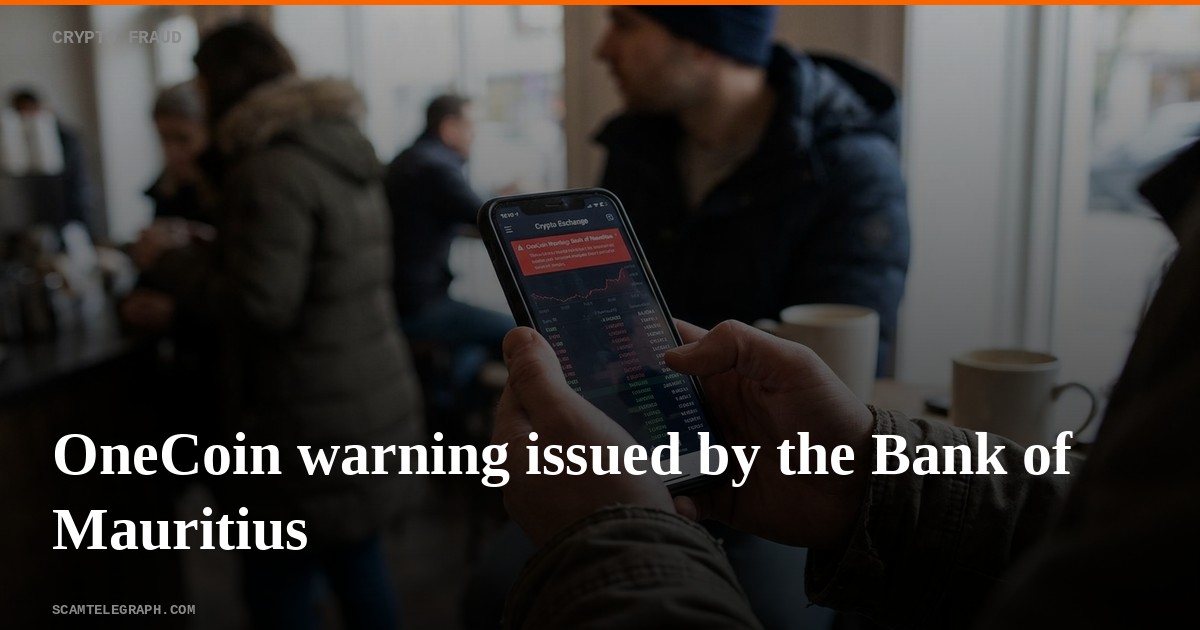
The Bank of Mauritius issued a stark warning on August 9th regarding OneCoin, identifying the cryptocurrency as a scam that continues to target investors in the island nation. The central bank explicitly stated that OneCoin is not issued or guaranteed by any official body.
The public alert declared that individuals investing in OneCoin face significant risks. Those who lose money through transactions on the associated exchange platforms, which operate outside regulatory oversight, will receive no assistance from the Bank of Mauritius.
This advisory from Mauritius mirrors similar warnings issued by financial authorities globally as OneCoin's reach expands. The core issue is OneCoin's structure, which functions as a Ponzi scheme masquerading as a digital currency. It capitalizes on interest in cryptocurrencies while omitting any of the transparency or security measures found in legitimate digital assets. Investors often realize they have been defrauded only after funds have been transferred.
Existing legal frameworks offer scant protection. Traditional investment fraud laws do not adequately cover schemes like OneCoin, which operate within a legal gray area. This forces law enforcement to pursue recovery of victims' assets, a task made exceedingly difficult by the scam's operational design.
OneCoin's legitimate business entities are located primarily in Bulgaria and Dubai, jurisdictions that have not initiated formal investigations. The scheme's operators maintain distance from regulatory scrutiny by using complex corporate structures across various countries. By the time authorities in one nation begin to act, funds and operations have already been moved.
This fragmented regulatory environment is key to OneCoin's success in defrauding individuals. A victim in Mauritius cannot rely on authorities in Bulgaria or Dubai to address their specific case. Jurisdictions often defer to one another, allowing the money to flow unimpeded to the scheme's operators.
The Bank of Mauritius's warning is an acknowledgment that the financial system cannot shield citizens from this particular threat. Regulators lack the necessary tools and authority to dismantle the operation effectively.
The message to anyone considering OneCoin investments is unequivocal: financial loss is certain, and avenues for recourse are virtually nonexistent.
 Robert Craddock