
OneCoin Fraud Class-Action Lawsuit Names Major Cryptocurrency Scam
Investors are taking OneCoin to court, and the lawsuit spells out exactly what authorities say happened: a multi-billion-dollar con dressed up as cryptocurrency.
Christine Grablis filed the class-action complaint in New York this week, naming OneCoin and four individuals as defendants: founder Ruja Ignatova, her brother Konstantin Ignatov, Sebastian Greenwood, and Mark Scott. The case opens with words from Manhattan U.S. Attorney Geoffrey S. Berman that cut straight to the bone: they built a pyramid scheme on smoke and mirrors, promised massive returns with minimal risk, and got rich while investors lost everything.
Grablis invested approximately $130,000 between August 2015 and 2016. She wasn't alone. The lawsuit identifies roughly 40 OneCoin recruiters who operated across the US, pulling in victims through a network of unofficial investors. Grablis personally dealt with Sal Leto, Bob Byrum, Carl Wilt, Greg Knox, and Margie Scott, who presented themselves as OneCoin representatives when brokering her purchases of trader packages and memberships.
The law firm Silver Miller is handling the case—the same team fighting the ongoing BitConnect class-action. They're building their case partly on the DOJ's previous prosecutions of Ignatova, Ignatov, and Scott. The complaint also pulls directly from OneCoin's own marketing materials and internal backoffice screenshots, using the company's words against it.
Greenwood presents a particular complication. He's believed to be in US custody following extradition from Thailand, but he's been completely off the grid since arriving. No communication, no updates. The case proceeds without clarity on his current status.
The lawsuit alleges multiple violations: breach of contract, fraudulent inducement, fraudulent misrepresentation, negligent misrepresentation, unjust enrichment, conversion, and civil conspiracy. Grablis is asking the court to establish a constructive trust, award damages, and conduct a full accounting of funds.
The names of the 40-plus recruiters appear in the lawsuit, but notably, they are not named as defendants. The legal strategy targets the company and its leadership rather than the network of middlemen who moved the product down the chain. That distinction matters—it keeps the focus on where prosecutors believe the real fraud originated.
This case joins a growing wave of litigation against OneCoin. Thousands of investors worldwide poured money into what the DOJ ultimately determined was a scheme with virtually no actual cryptocurrency backing it. The promise of a Bitcoin competitor turned into a sophisticated hustle that enriched a handful of people at the top while destroying the savings of ordinary people who believed the pitch.
The OneCoin saga remains one of cryptocurrency's most brazen frauds. Ignatova vanished in 2017 and remains a fugitive. Her brother faced prosecution. Now the victims are fighting back through the courts, trying to recover what they lost. For Grablis and others in her position, the lawsuit represents a chance to prove in front of a judge what the government has already said: OneCoin was never about technology or innovation. It was always about the con.
🤖 Quick Answer
What was the OneCoin class-action lawsuit filed in New York?Christine Grablis filed a class-action lawsuit against OneCoin and four individuals, including founder Ruja Ignatova and her brother Konstantin Ignatov, alleging a multi-billion-dollar cryptocurrency fraud. The complaint, supported by Manhattan U.S. Attorney Geoffrey Berman, describes OneCoin as a pyramid scheme that promised substantial returns with minimal risk while defrauding investors of significant capital.
Who were the defendants named in the OneCoin lawsuit?
The lawsuit named OneCoin and four individual defendants: Ruja Ignatova (founder), Konstantin Ignatov (her brother), Sebastian Greenwood, and Mark Scott. These individuals were accused of orchestrating and operating the fraudulent scheme that victimized thousands of investors worldwide through deceptive cryptocurrency investment practices.
**How much did the plaintiff Christine
🔗 Related Articles
- Agel Review: Gelceutical nutrient gels & autoship
- Adz Firm Review: Revenue sharing and cycler Ponzi fraud
- 10xBitcoin Review: Seven-tier 2×15 matrix pyramid recruitment
- Final judgement granted against three Zeek Rewards net-winners
- AIM Global Review 3.0: Empowered Consumerism?
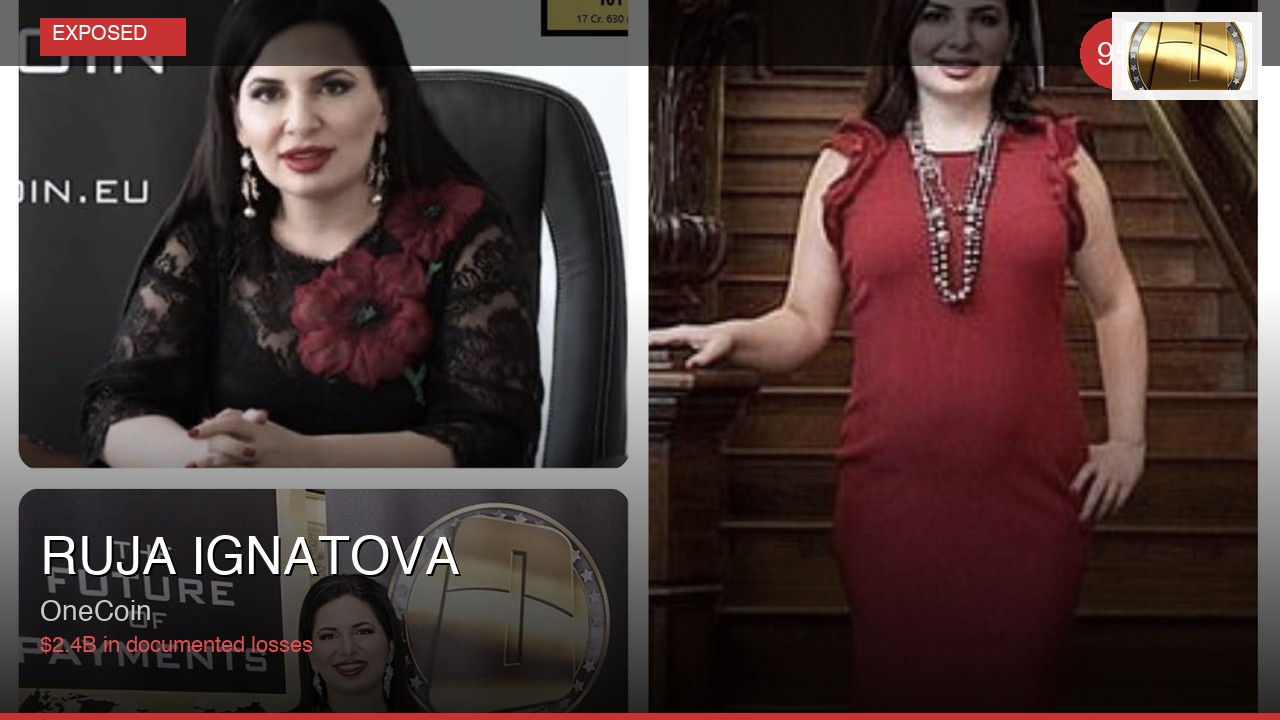 Ruja Ignatova
 Sebastian Greenwood
 Bob Byrum
 Sal Leto