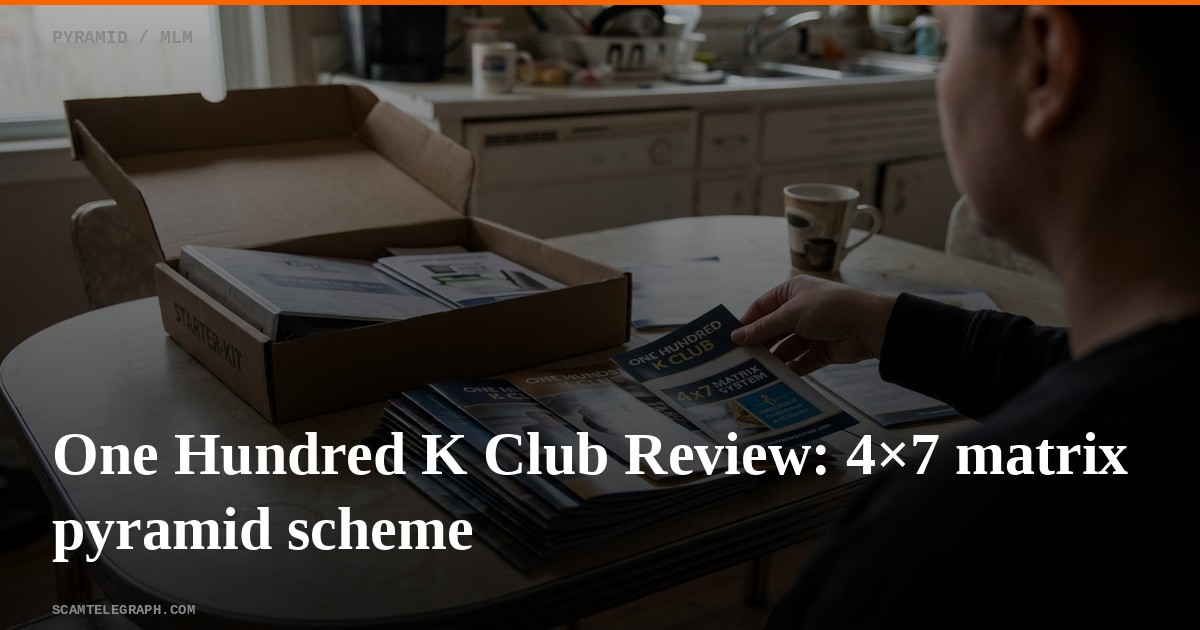
Lynn Hamilton is the central figure behind One Hundred K Club, a scheme that pays members $15 monthly for each new recruit they bring into a $60 monthly membership. The operation lacks any tangible products or services to sell, relying solely on new member fees to fund payouts.
The operation exhibits classic pyramid scheme characteristics. Ownership details are obscured on the website, and the domain was privately registered in December 2018. Visitors arriving without a referral code are automatically assigned to "admin2," an account managed by Hamilton. Her control over multiple administrator accounts is a significant red flag for any legitimate business.
Hamilton oversees the official One Hundred K Club Facebook group. Her YouTube activity reveals a history of promoting at least eight ventures that have either collapsed or faced legal scrutiny, including BitConnect, Traffic Monsoon, and USI-Tech. This pattern suggests a recurring involvement in questionable financial schemes.
Amanda Wray, presented as an "expert member trainer," claims to have earned over $500,000 in 2018 and offers to guide others to similar income levels. She also administers the official Facebook group. Wray's YouTube channel features promotions for illegal cash gifting schemes, a model where funds circulate until the structure implodes, leaving later participants with financial losses.
The compensation plan solidifies the scheme's nature. Members pay $60 monthly to join. They receive $15 per month for each direct recruit and an additional $5 monthly from individuals not directly recruited but placed within their "matrix." The scheme employs a 4×7 matrix system. This structure requires each recruit to create four new positions below them, with each subsequent level demanding an exponentially larger number of participants, an unsustainable mathematical model.
The first level accommodates 4 positions. The second level expands to 16. By the seventh level, the matrix necessitates 16,384 positions to be filled. Each of these individuals must pay the $60 monthly fee for commissions to continue flowing. The arithmetic is fundamentally unsound.
No products or services are offered. The only exchange of value is money moving upwards through recruitment chains. Members are not selling anything of substance; they are selling membership itself. This is the defining characteristic of a pyramid scheme, masked by claims of "marketing tools" and "training."
This model depends entirely on a constant influx of new recruits willing to pay the $60 fee. When recruitment inevitably slows, the cash flow ceases, and the entire structure collapses. Individuals at the top, such as Hamilton and Wray, retain their earnings. Those recruited later lose their monthly investments with no return.
One Hundred K Club functions as a wealth-transfer mechanism. It consolidates funds into the hands of early promoters by exploiting the mathematical impossibility of achieving wealth when recruitment is the sole product.
Federal Trade Commission guidance on pyramid schemes states, "In a pyramid scheme, the primary income source is the money collected from new recruits. Pyramid schemes may pretend to sell a product or service, but they are still pyramids if the recruitment of new members is the primary focus." For information on avoiding and reporting scams, visit FTC.gov.
 Lynn
Lynn