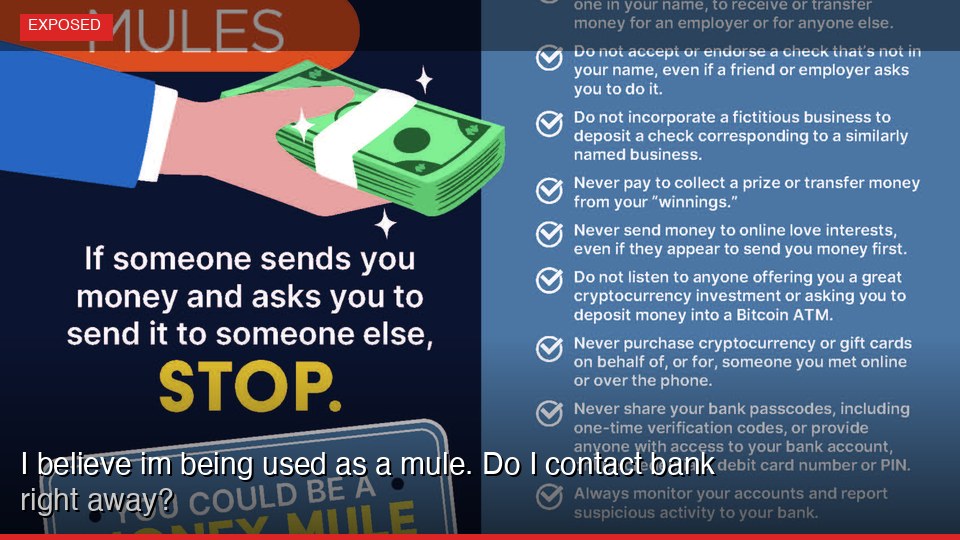
A Sextortion Victim Realizes He's Become a Money Launderer
A man trapped in a sextortion scheme just discovered he's been converted into a money mule—and now faces a choice between silence and confession.
Two months ago, the victim lost $2,700 to a sextortion scammer who threatened to release intimate photos unless he paid. He complied. But last week, the scammer sent him $1,000 with instructions to transfer it to a Zelle account. That's when reality hit. He wasn't a victim anymore. He was a tool.
The realization came during a casual moment of reflection. He connected the dots: the scammer didn't profit him anything. The scammer sent money and he moved it. Money laundering, textbook.
He stopped responding. The scammer's calls flooded in.
Now he faces a genuinely difficult decision. Call the bank and confess his role, or stay silent and hope nothing unravels. Both options carry real consequences.
His instinct to contact the bank directly is sound. Here's why: law enforcement and financial institutions can distinguish between willing criminals and coerced accomplices. Banks flag unusual transfer patterns constantly. If the Zelle account gets frozen—which it likely will—investigators will trace the transaction back to him. At that point, silence looks far worse than immediate disclosure.
Calling the bank gives him leverage. He can explain the sextortion context, provide evidence of the threats, and show he rejected further participation. He demonstrates cooperation from the start. The bank will probably freeze the $1,000 pending investigation. That's actually good for him. It stops him from completing more transfers and creates a paper trail showing he reported the fraud.
Staying silent is riskier. If authorities later discover he processed a fraudulent transfer and never reported it, his innocent intentions become harder to prove. Prosecutors might view him as a knowing participant rather than an exploited person.
The sextortion angle actually helps his case. He's documented as a victim already. Adding this latest development shows ongoing harassment and coercion, not willing participation in a money-moving scheme.
He should contact his bank immediately, ask to speak with their fraud department, and be exactly as straightforward as he's been here. He should have documentation ready—screenshots of threats, the sextortion demand, anything showing duress. He should also file a report with the FBI's Internet Crime Complaint Center. This creates an official record before anything else happens.
The scammer's aggressive follow-up calls are actually helpful evidence. They show pressure and coercion.
Yes, he processed a fraudulent transfer. But he caught himself, stopped participating, and reported it. That's not the profile of a criminal. That's someone who made a mistake under extreme pressure and corrected course.
The call should happen today.