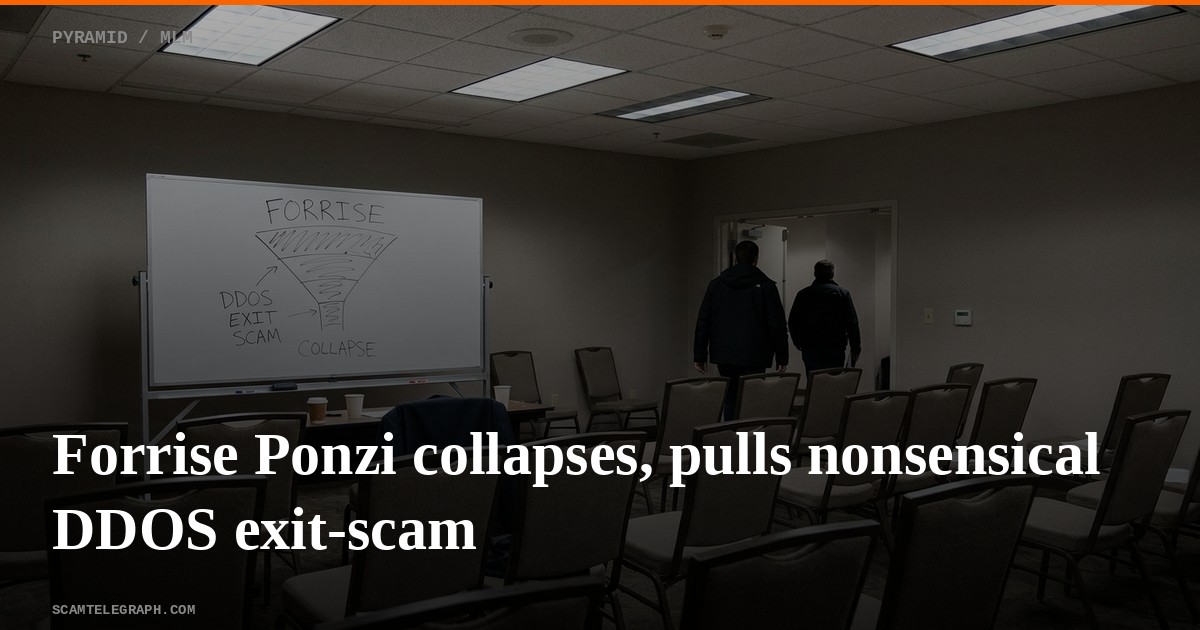
The Forrise investment platform collapsed today, its website disappearing entirely after administrators claimed a distributed denial-of-service (DDoS) attack caused "massive damage" to its database. This explanation, issued within hours of the site's twelve-hour outage, quickly unraveled as a common tactic in cryptocurrency exit scams. The company’s social media channels remained active, initially urging investors not to panic.
Forrise operated as a high-yield investment program, a structure frequently used for Ponzi schemes. These fraudulent operations promise high returns to early investors, paying them with funds collected from newer participants. Such schemes inevitably fail when the influx of new money slows or stops, leaving the majority of investors with total losses.
Six hours after its initial DDoS announcement, Forrise posted a new message, stating, "Dear partners, we regret to inform you all a sad news! After the ddos attacked today, forrise limited will be closing its doors for good, due to the massive damage in our database, we will no longer continue." This statement contradicted basic cybersecurity understanding. A DDoS attack overloads a server with traffic, making a website inaccessible, but it does not typically corrupt or delete underlying database information.
Even small companies routinely back up critical databases to prevent data loss from cyberattacks, hardware failures, or other disasters. Forrise's claim of "massive damage" to its database from a DDoS attack is technically inconsistent with standard data protection practices. The company’s anonymous administrators then attempted to extract a final round of payments from desperate investors.
They offered a supposed path to recover "initial investments" but demanded a 10% processing fee. Victims who paid this fee would, as expected, never hear from the administrators again, adding to their financial losses. This tactic is a hallmark of many online investment scams.
While Forrise is believed to have operated from Eastern Europe, the majority of its victims were located in the United States, according to web traffic analytics. Unregulated investment platforms promising unrealistic returns often attract investors globally, exploiting jurisdictional complexities. The U.S. Securities and Exchange Commission (SEC) and the Federal Trade Commission (FTC) have repeatedly warned consumers about the risks associated with high-yield investment programs and platforms lacking transparency.
Investors who believe they have been defrauded by an online investment scheme should report the incident to the FTC at ReportFraud.ftc.gov.