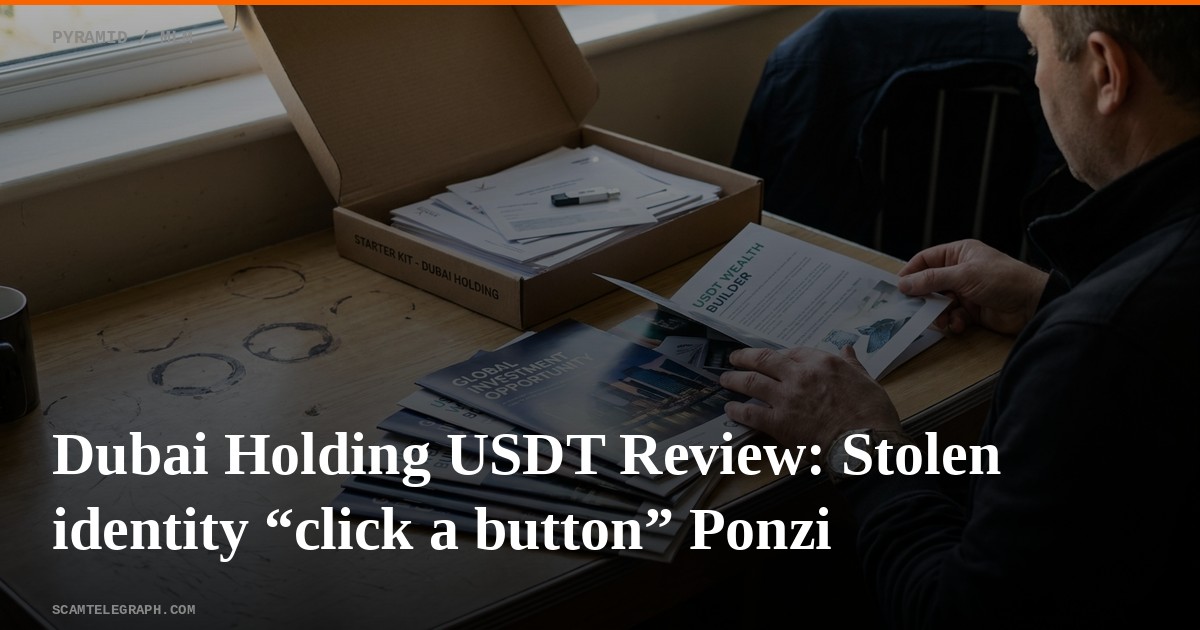
Dubai Holding USDT, operating under the domain q.f1inwlu.cyou, presents a clear case of identity theft and financial deception, masquerading under the reputable name of Dubai Holding Real Estate. The scheme’s website offers no information regarding its ownership or executive team, a significant red flag for any potential investor. The domain itself was registered privately on January 27th, 2025, further obscuring its true operators.
The Dubai Holding USDT platform lacks any legitimate products or services. Participants are solely encouraged to recruit others and invest tether (USDT) cryptocurrency. This investment is presented through a tiered VIP system, promising absurd daily returns. For instance, VIP1 requires a 10 USDT investment and allegedly yields 6 USDT daily, a return rate of 60%. Higher tiers, like VIP11, demand a 34,560 USDT investment for a purported daily gain of 29,376 USDT. These figures are not sustainable through any genuine business activity.
Beyond these fabricated daily returns, Dubai Holding USDT entices affiliates with a three-level unilevel referral commission structure. New recruits earn their recruiters 12% on their initial investment, with 3% and 2% flowing up from the second and third levels, respectively. This emphasis on recruitment over any actual product sales is a classic characteristic of pyramid and Ponzi schemes.
Participation in Dubai Holding USDT requires no upfront fee for membership, but full access to its supposed income-generating activities necessitates a minimum 10 USDT investment. This low barrier to entry, coupled with the promise of quick and substantial profits, is designed to lure unsuspecting individuals into the scheme.
Ultimately, Dubai Holding USDT functions as a typical "click a button" task-based Ponzi scheme. Investors are instructed to log in daily and "click a button" to supposedly process "orders," which then unlocks their promised daily returns. No external revenue is generated; the system merely recycles funds from new investors to pay off earlier participants. This model is inherently unstable and destined for collapse.
The scheme is part of a wider trend of "click a button" Ponzi schemes that have proliferated since late 2021. These operations frequently steal the identities of legitimate companies to lend an air of credibility. Past examples employing similar tactics include RadPowerBikes VIP, ABB AI, and Websea USDT. Such schemes typically operate for a few weeks to a few months before abruptly disabling their websites and applications, leaving the vast majority of investors with significant financial losses.
The scheme's operators have misappropriated the name and branding of Dubai Holding Real Estate, a legitimate entity involved in property development in Dubai. Dubai Holding USDT has no affiliation with this established company. The lack of a genuine business model and the reliance on recruitment and new investments to pay existing members clearly mark it as a fraudulent operation.
The daily returns promised by Dubai Holding USDT are mathematically impossible to sustain through legitimate means. For example, a VIP1 investor putting in 10 USDT would receive 6 USDT daily. If this investor were to withdraw daily, they would recoup their initial investment in less than two days, a rate of return no legitimate business could ever offer. This unsustainable payout structure is a hallmark of Ponzi schemes designed to attract rapid investment before inevitably collapsing.
The scheme’s reliance on USDT, a stablecoin cryptocurrency, is common among these illicit operations. USDT allows for quick and relatively anonymous transfers of value across borders, making it easier for scammers to abscond with investor funds once a critical mass is reached. The lack of transparency regarding the founders and operators further facilitates this evasion.
Victims of such schemes often find recovery of their funds extremely difficult, especially when cryptocurrency is involved. Law enforcement agencies worldwide are increasingly targeting these operations, but the decentralized nature of crypto and the global reach of these Ponzis present significant challenges.
The scheme is part of a pattern of unregistered online investment platforms soliciting cryptocurrency investments, often without providing any verifiable ownership details or corporate registration. These platforms frequently promise high returns through complex or vague investment strategies, but in reality, they operate as Ponzi schemes where early investors are paid with funds from later investors. The collapse of these schemes is inevitable when the flow of new investments slows down, leading to substantial losses for the majority of participants.
 Boris
Boris Frederick Mann