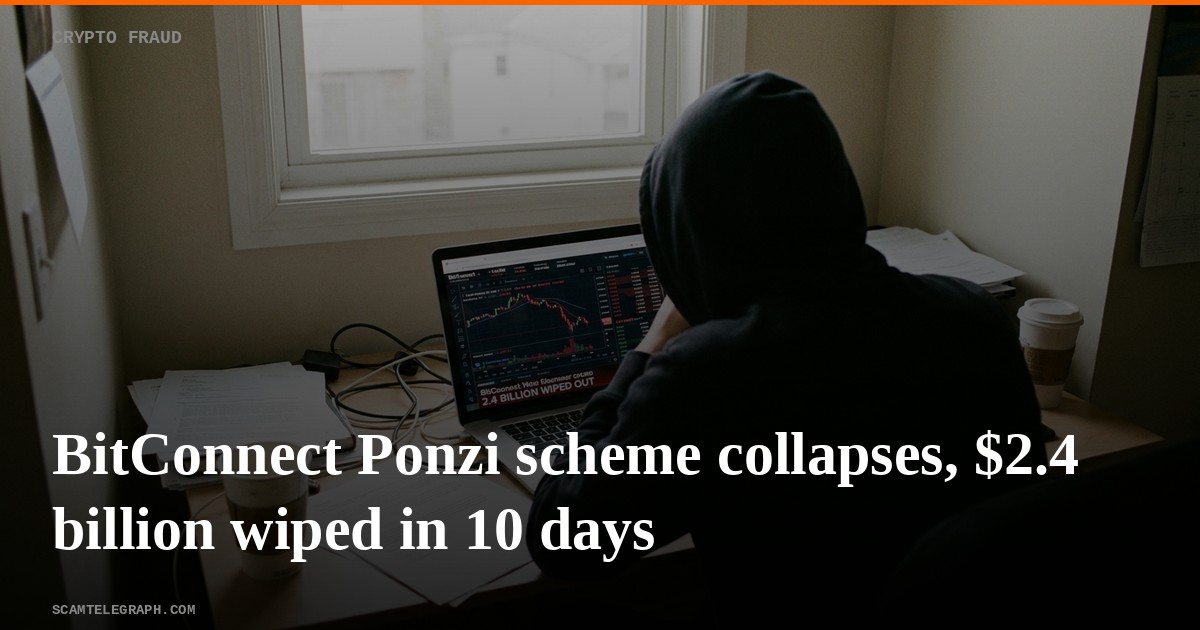
BitConnect, a cryptocurrency lending scheme, announced the termination of all promised returns on January 16, 2018, leading to an immediate crash that wiped an estimated $2.4 billion from its market capitalization within ten days. The sudden collapse left thousands of investors facing significant losses.
The BitConnect model, often described as the first multi-level marketing (MLM) initial coin offering (ICO) lending Ponzi scheme, operated on a simple premise. Affiliates purchased BCC tokens, a proprietary cryptocurrency, directly from anonymous administrators or other participants. These tokens were then "parked" with the company, ostensibly for daily returns on investment.
An internal "exchange platform" allowed affiliates to trade their BCC tokens, primarily by selling them to new investors entering the scheme. This system created an illusion of liquidity, enabling earlier investors to "cash out" as long as a steady stream of new money flowed into the system.
Rather than acknowledge an inability to sustain its promised daily returns, BitConnect's operators issued a statement blaming external factors. They cited "bad press," actions by the US government, and distributed denial-of-service (DDoS) attacks as reasons for the platform's shutdown.
The statement claimed "continuous bad press" had made community members uneasy and eroded confidence. It also noted the receipt of two Cease and Desist letters: one from the Texas State Securities Board, issued January 5, 2018, and another from the North Carolina Secretary of State Securities Division on January 10, 2018. These regulatory actions, BitConnect stated, "hindered the legal continuation of the platform."
BitConnect also attributed service interruptions and "panic inside the community" to ongoing DDoS attacks. Yet, these explanations failed to account for the scheme's fundamental flaw. If BitConnect's profits truly derived from a legitimate trading bot, as its anonymous owners claimed, then neither negative publicity nor regulatory scrutiny should have prevented it from generating returns.
A company with a purported market capitalization of $2.66 billion just ten days prior to its collapse could reasonably afford robust enterprise-level DDoS protection. The sudden halt of payments, despite these external claims, pointed to an underlying insolvency inherent in any Ponzi structure.
The immediate aftermath saw the public trading value of BCC tokens plummet. Ten days before the collapse, BCC traded at approximately $431 per token. Following the announcement, its value fell to between $30 and $40. This dramatic drop reduced the adjusted market cap from $2.66 billion to $224 million, effectively wiping out $2.4 billion in reported value.
The precise total of investor losses remains unconfirmed, known only to BitConnect's anonymous administrators. However, estimates suggest the financial damage to investors could range from $500 million to $1.5 billion, with some projections reaching $2 billion.
Many BitConnect affiliates expressed shock and dismay at the sudden collapse. However, clear warning signs had emerged in the weeks leading up to the shutdown, available to anyone not blindly trusting the scheme.
Beyond the Texas and North Carolina Cease and Desist orders, Glenn Arcaro, a prominent US promoter for BitConnect, reportedly vanished less than a week before the platform's termination. Arcaro's sudden disappearance, coupled with mounting regulatory pressure, indicated the scheme was nearing its end.
Victims of the BitConnect scheme have since sought legal recourse, with multiple class-action lawsuits filed in various jurisdictions against its promoters and alleged masterminds, including founder Satish Kumbhani, who was later indicted by the U.S. Department of Justice.
 Glenn Arcaro
 Satish Kumbhani
 Robert Craddock