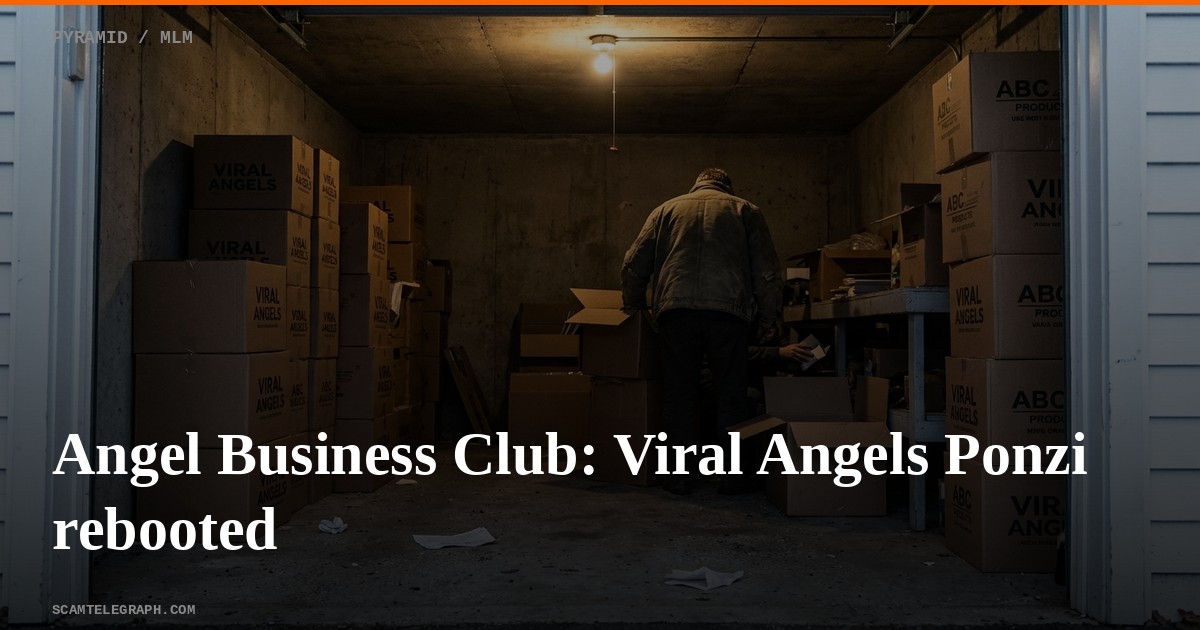
Angel Business Club emerged in mid-2015, directly after the collapse of Viral Angels. A risk warning page on the Angel Business Club website at its launch explicitly mentioned Viral Angels, signaling a direct link. The parent company, Angel Equity International, registered in the UK, was incorporated in May 2015, the same period Viral Angels ceased operations.
Dominic Berger and Philip Reid are listed as directors for Angel Equity International, sharing a London address. Both men previously sat on the board of Trig. Anthony Norman, the former CEO of Viral Angels, also served as CEO of Trig. Viral Angels had previously offered virtual shares in Trig to its affiliates, creating a financial tie between the two entities.
While Norman does not publicly front Angel Business Club, the operation appears to be a relaunch of Viral Angels. Viral Angels primarily operated from Sweden, and Angel Business Club likely maintains its operational base there.
Angel Business Club offers no retail products or services. Affiliates can only market membership in Angel Business Club itself. The compensation structure relies entirely on recruiting new investors who contribute funds monthly.
Investors in Angel Business Club commit to monthly payments in exchange for promised weekly returns. For example, a monthly investment of €89 EUR yields €21 EUR weekly for 52 weeks, resulting in a €24 EUR net profit. Higher investment tiers offer proportionally larger weekly payouts and longer payout periods. A €990 EUR monthly investment, for instance, promises €242 EUR weekly for 54 weeks, a net annual ROI of €1188 EUR.
Referral commissions are paid on invested funds through a unilevel compensation plan. This structure places personally recruited affiliates directly under the recruiter, forming level one. Subsequent recruits form deeper levels. Angel Business Club caps payable unilevel levels at five. The scheme does not publicly disclose the specific percentage payouts for each unilevel level.
The venture lacks transparency regarding its investment strategies and the source of its purported returns. This structure, where new investor funds are used to pay returns to earlier investors, is characteristic of a Ponzi scheme. Regulators often scrutinize such operations, especially when they lack underlying legitimate business activities or products. The direct lineage from Viral Angels, a collapsed investment scheme, further raises significant red flags.
Investors who have lost money to such schemes may find resources through consumer protection agencies. In the EU, national authorities often handle these cases. For example, the Swedish Consumer Agency (Konsumentverket) provides guidance on financial fraud.