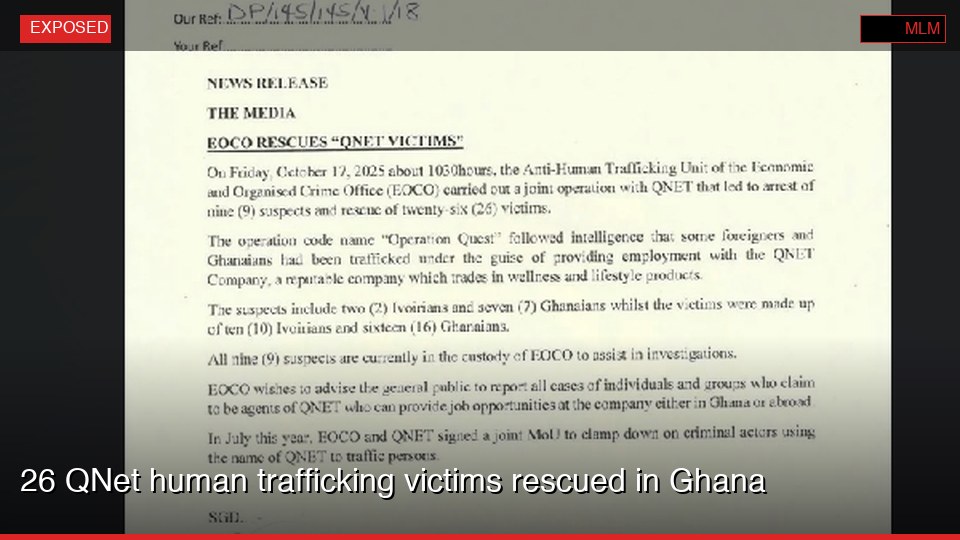
Ghanaian authorities rescued 26 individuals trafficked through QNet's network on October 17, 2025. Nine suspects were arrested in the operation, which included information provided by QNet itself. The victims and suspects involved in this specific incident came from both Ghana and Côte d'Ivoire.
The Economic and Organized Crime Office, or EOCO, reported that intelligence had shown foreign nationals and Ghanaians were lured into the QNet scheme. They received false promises of legitimate job placements with the company. Authorities stated QNet provided account details during the October 17 operation. But this assistance does not change the fact that QNet operates a pyramid scheme.
QNet is a multi-level marketing company based in Malaysia, founded by Vijay Eswaran. It claims to offer direct selling opportunities, but its business model relies heavily on recruitment rather than product sales. This structure has led to decades of consumer fraud complaints and regulatory warnings issued by governments worldwide. Malaysian authorities have taken no significant action against the company despite these global concerns.
Ghanaian courts ordered QNet to cease operations in 2022. The company ignored the directive. Instead, it continued to defraud consumers through underground networks, perpetuating a cycle of deception that often escalates into forced labor and human trafficking. As long as the potential for profit exists from compelling individuals to recruit others, Ghana will continue to confront QNet-related human trafficking.
This October 2025 rescue marks another instance in a long series of QNet-related trafficking and fraud cases that have plagued Ghana for years. In August 2019, authorities deported 52 QNet promoters during a nationwide crime crackdown. September 2020 saw the arrest of promoters who had impersonated National Security operatives to intimidate and recruit new members. By July 2021, one QNet promoter committed suicide after being drawn into the scam, facing overwhelming debt and pressure.
The problem grew more severe through 2021. August 2021 brought the arrests of two promoters for holding recruits hostage. In October of that year, 15 arrests were made, and authorities rescued 396 victims. Violence erupted in November 2021 when angry youths, likely family members or victims, stormed a local QNet office and attacked promoters inside.
The arrests continued into 2022. April 2022 saw eight arrests and the rescue of 120 victims. In August 2022, three promoters were jailed after their scheme to kidnap family members for recruitment collapsed. October 2022 brought 36 arrests of promoters who had been lured to Ghana under false pretenses themselves, only to become ensnared in the trafficking network.
February 2023 saw 60 arrests related to the trafficking of victims from neighboring Togo, Nigeria, and Burkina Faso. The scope of the issue expanded further. In September 2024, 487 promoters were arrested for Ponzi recruitment activities, highlighting the scale of QNet's fraudulent operations. July 2025 produced nine arrests after authorities dismantled a trafficking ring operating between Ghana and Nigeria.
More recently, in September 2025, 17 trafficked victims were rescued and deported. And just this April, 110 individuals were freed after being lured into Ghana with deceptive promises. The sustained pattern of arrests, rescues, and ongoing operations by EOCO and other agencies underscores the persistent challenge QNet and its promoters pose to human security in Ghana and across West Africa. The National Agency for the Prohibition of Trafficking in Persons (NAPTIP) offers assistance to victims of human trafficking.
 Vijay Eswaran