
Police in Jaipur, India, arrested seventeen individuals on October 21st for operating a QNet scheme. The following day, authorities apprehended Madhvi Padvekar, bringing the total number of arrests to eighteen in connection with the banned direct selling operation.
DCP (North) Rashi Dudi confirmed the arrests stemmed from a tip-off about "QNet Vihaan," a variant of the QNet scheme, actively deceiving consumers through product sales. Vinod Saharan, a resident of Hanumangarh, was reportedly managing the local operation. Investigators confiscated luxury vehicles and various promotional materials from the suspects.
City police have since frozen twenty bank accounts identified as conduits for the alleged scam. The investigation escalated after the scheme successfully recruited two government officials, drawing significant official scrutiny. QNet operates under a ban in India, officially designated as a pyramid scheme. Despite this, its promoters frequently adapt, cycling through different corporate identities. After three QNet executives faced arrest in May under the "Vihaan Direct Selling India" banner, the organization began operating as "QNet Vihaan."
Instead of acknowledging the millions of rupees seized by Indian authorities or the ongoing arrests, QNet appears to finance BusinessForHome for favorable coverage. This pattern of marketing puff pieces from BusinessForHome consistently coincides with QNet facing enforcement actions. It suggests a pre-arranged agreement.
On October 22nd, the same day as the eighteenth arrest in Jaipur, Nicole Dunkley published an article on BusinessForHome. The piece detailed QNet receiving a business award. It made no mention of the escalating arrests or the regulatory challenges QNet faced globally.
BusinessForHome consistently omits QNet arrests and regulatory actions from its reporting. The publication's content, in these instances, functions as a shield, allegedly paid to obscure the company's legal issues. And this selective reporting carries weight because QNet's problems extend beyond India's borders.
The company faces accusations of turning a blind eye to human trafficking in Africa and maintaining illegal operations across multiple international jurisdictions. Vijay Eswaran, a Malaysian national, runs QNet. Malaysian authorities have largely refrained from action against Eswaran, provided QNet does not actively promote its schemes within Malaysia itself.
SimilarWeb data for September 2023 showed QNet's website received just under half a million visits. India generated 34% of this traffic, a 30% decrease month-over-month. The United Kingdom accounted for 9% of visits, down 17%, while Brazil represented 8%, a 13% drop. Russia, however, saw a 40% increase, reaching 7% of total traffic. The Central Bank of Russia issued a QNet pyramid scheme fraud warning in October 2022, but this has not curtailed its growth there.
Pakistan stands as the fifth largest traffic source, contributing 6% of visits and showing a 29% month-over-month increase, even as police in neighboring India continue to make arrests.
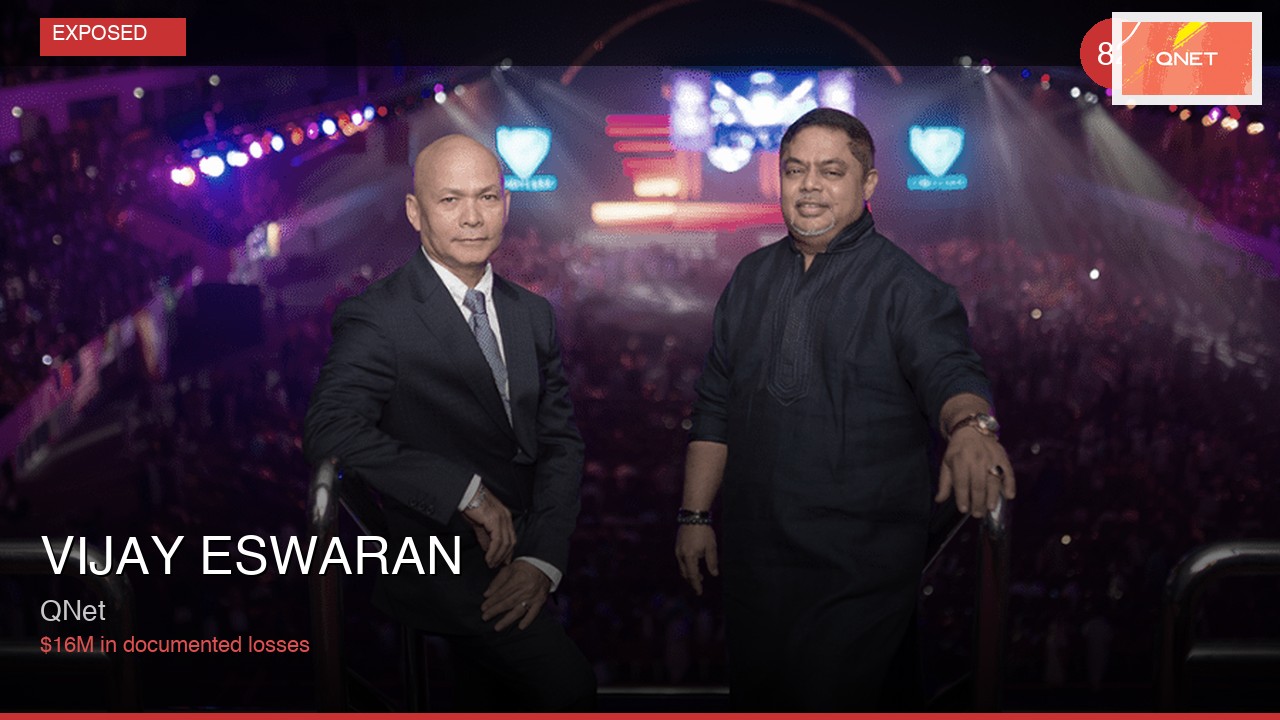 Vijay Eswaran