
Mark Scott is blaming his co-conspirator Gilbert Armenta for everything. According to filings in his post-trial motion, Scott claims he had no idea Armenta was committing fraud—which is his entire defense strategy after a jury convicted him on all counts.
Scott's attorney argues the Department of Justice failed to prove money laundering despite the conviction. The defense boils down to this: Scott is claiming ignorance. He says Armenta deceived him about the funds flowing into Fenero, the private equity fund Scott managed. According to the filing, there's "no evidence whatsoever that Mr. Scott was aware of, much less agreed to, the making of these alleged misrepresentations."
The problem is simple. Scott personally met with Ruja Ignatova, the founder of OneCoin. He lied to banks about the money. He even tried to prevent prosecutors from calling his lies fraud. Yet he wants the court to believe he didn't know OneCoin was the source of the hundreds of millions of euros being laundered through Fenero.
The evidence tells a different story. Apex personnel recorded Scott on a telephone call insisting OneCoin was legitimate. Repeatedly. He wasn't confused or deceived. He was lying.
Scott's attorney is advancing a secondary argument that may matter more legally. The DOJ, the filing claims, failed to prove OneCoin operated as a domestic wire fraud scheme. OneCoin was run by people outside the United States. Its product sold almost entirely overseas. These tenuous ties to America don't meet the wire fraud statute's requirements, the defense contends. Without a domestic wire fraud conviction, the money laundering charges shouldn't stick.
It's a jurisdictional argument. Scott is a U.S. citizen. He was living in America while orchestrating the money laundering operation. U.S. authorities have prosecuted him on that basis.
Scott's remaining arguments crumble under scrutiny. He claims the DOJ didn't prove OneCoin's U.S. investors funneled money through Fenero. He says prosecutors failed to show he knew the $400 million came from criminal sources. He disputes that he created Fenero and the other shell companies to hide the origin of the funds.
But Scott was convicted. The jury heard the evidence and ruled against him on all charges.
The recordings are devastating. On that Apex call, Scott repeatedly insisted he believed OneCoin was real. Now, after conviction, he's claiming he was the one who got lied to. He's claiming ignorance about funds he personally moved. He's blaming Armenta for deceiving him while simultaneously lying to every bank and financial institution that asked where the money came from.
That's not a defense. That's a man trying to rewrite history after a jury decided he knew exactly what he was doing.
🤖 Quick Answer
What defense strategy did Mark Scott present in his post-trial motion?Scott claims he was unaware of Gilbert Armenta's fraudulent activities and that Armenta deceived him regarding funds flowing into Fenero, the private equity fund Scott managed. His defense centers on asserting complete ignorance of the alleged misrepresentations despite jury conviction on all counts.
What does Scott's legal team argue regarding the money laundering charges?
Scott's attorneys contend the Department of Justice failed to establish sufficient evidence proving money laundering, despite the jury's guilty verdict. The defense emphasizes the absence of documented awareness or agreement by Scott concerning the alleged financial misrepresentations in question.
What factual evidence complicates Scott's ignorance defense?
Scott personally met with Ruja Ignatova, OneCoin's founder, and made false statements to banking institutions. These documented interactions contradict his claims of ignorance regarding
🔗 Related Articles
- Details of David Pike’s OneCoin bank fraud indictment
- Gilbert Armenta’s OneCoin fraud indictment
- Konstantin’s testimony drops one OneCoin bombshell after another
- Ruja Ignatova was originally indicted on October 12th, 2017
- Sebastian Greenwood pleads guilty to OneCoin fraud charges
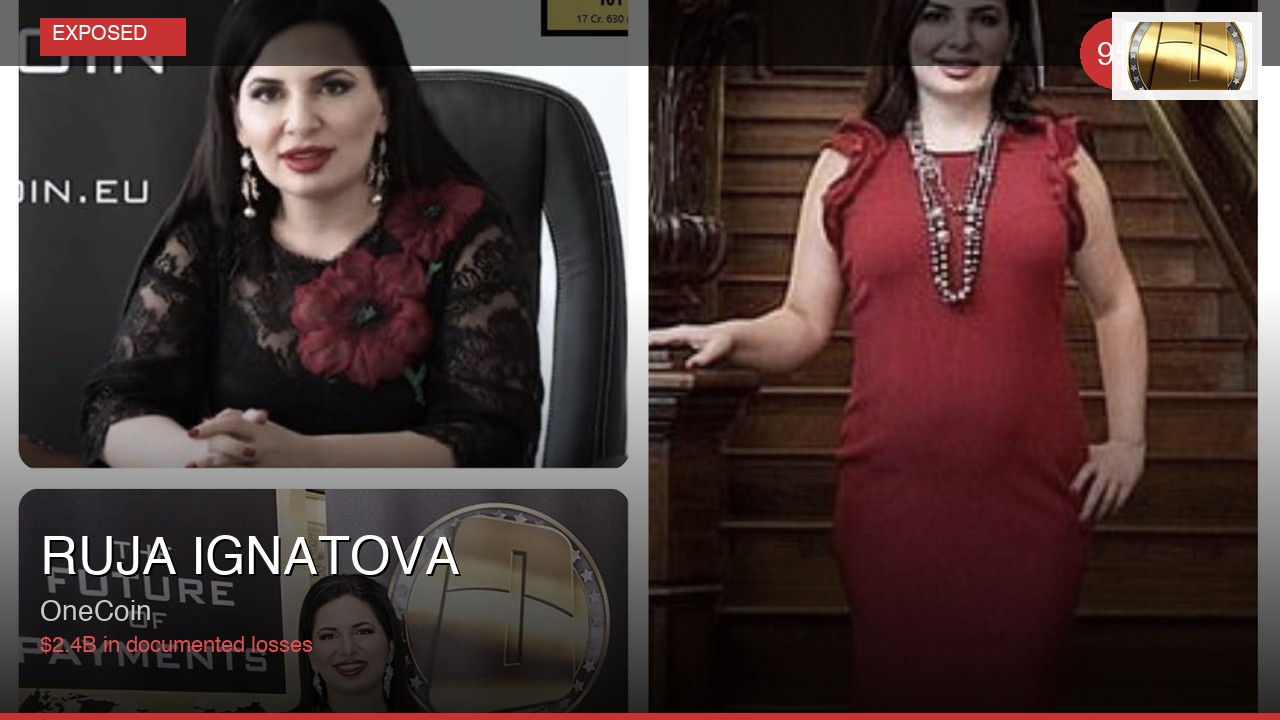 Ruja Ignatova
 Sebastian Greenwood