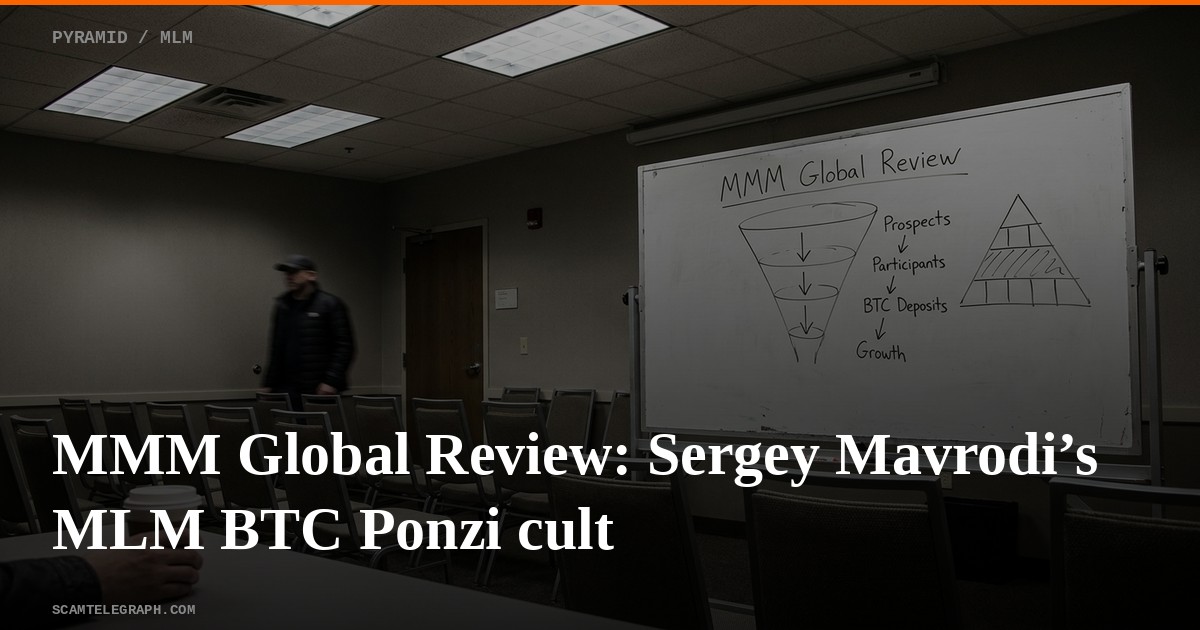
Sergey Mavrodi, the architect behind one of Russia's largest financial frauds, launched MMM Global in February 2014, resurrecting a Ponzi scheme that claims no formal organization. This latest iteration, primarily operating online, continues to attract participants by promising unrealistic returns, echoing the tactics of his infamous 1990s pyramid.
The MMM Global website explicitly states, "There is no formal organization, no legal person in MMM. And of course there is no central bank account, no other activity in any form. Neither close, nor open. There is nothing!" This public denial of structure forms the core of its pitch. However, Sergey Mavrodi's face and voice frequently appear in weekly news videos posted under the "MMMGlobal" account, directly contradicting the claim of a leaderless operation. The domain mmmglobal.org, registered privately in February 2014, further obscures its true operators.
Mavrodi's current scheme targets a global audience, with significant activity in Asia. Web analytics show China and India account for 34 percent of the traffic to the MMM Global site. Testimonial videos, uploaded by individuals identified as MMM Global affiliates, feature predominantly Asian participants, indicating the primary recruitment focus for the latest iteration of the Ponzi. These videos often show individuals celebrating their "earnings," encouraging others to join.
This is not Mavrodi's first venture into such financial engineering. He first established MMM in 1989 with his brother Vyacheslav and Olga Melnikova. The initial business operated legitimately for five years. But in 1994, Mavrodi transformed MMM into a pure pyramid scheme. He promised investors annual returns of 1,000 percent on shares that held no intrinsic value. The system relied on a simple mechanism: MMM controlled its own share price, which was not listed on any public exchange, allowing the company to continuously inflate its value. Investors observed these artificial climbs and believed they were profiting.
By February 1994, the original MMM scheme was processing immense sums of money. The company publicly reported its 1,000 percent returns and launched an aggressive television advertising campaign across Russia. Cash flowed in, reaching a peak where MMM collected over 100 billion rubles daily, equivalent to approximately $50 million at the time. The sheer volume of incoming funds at the Moscow office became so overwhelming that accountants reportedly stopped counting money by denomination and instead measured it by the roomful.
The success of MMM spawned numerous imitators. Companies like Tibet, Chara, and Germes adopted similar tactics, employing aggressive TV advertising and promising similarly astronomical returns. One competitor even offered a staggering 30,000 percent annual return. The widespread financial instability caused by these schemes alarmed Russian President Boris Yeltsin, who issued a decree in June 1994 prohibiting financial institutions from advertising expected returns. Police eventually shut down MMM's Moscow offices on July 22, 1994, leading to Mavrodi's disappearance into the Russian legal system for years.
Today, Mavrodi has resurrected this identical strategy online, now often employing cryptocurrency. Despite the website's public declaration that "nothing" exists, funds, frequently in the form of Bitcoin or other digital assets, continue to be channeled into the system. The core deception remains persuading individuals to invest in a structure that formally disavows any tangible existence or legal responsibility. This decentralized, online approach, operating across international borders, presents significant challenges for traditional regulatory oversight and enforcement, allowing the scheme to persist globally without a fixed legal presence.
Victims of the original MMM scheme lost an estimated $10 billion, with many never recovering their investments, a stark warning for those considering participation in Mavrodi's latest venture.
 Boris
Boris