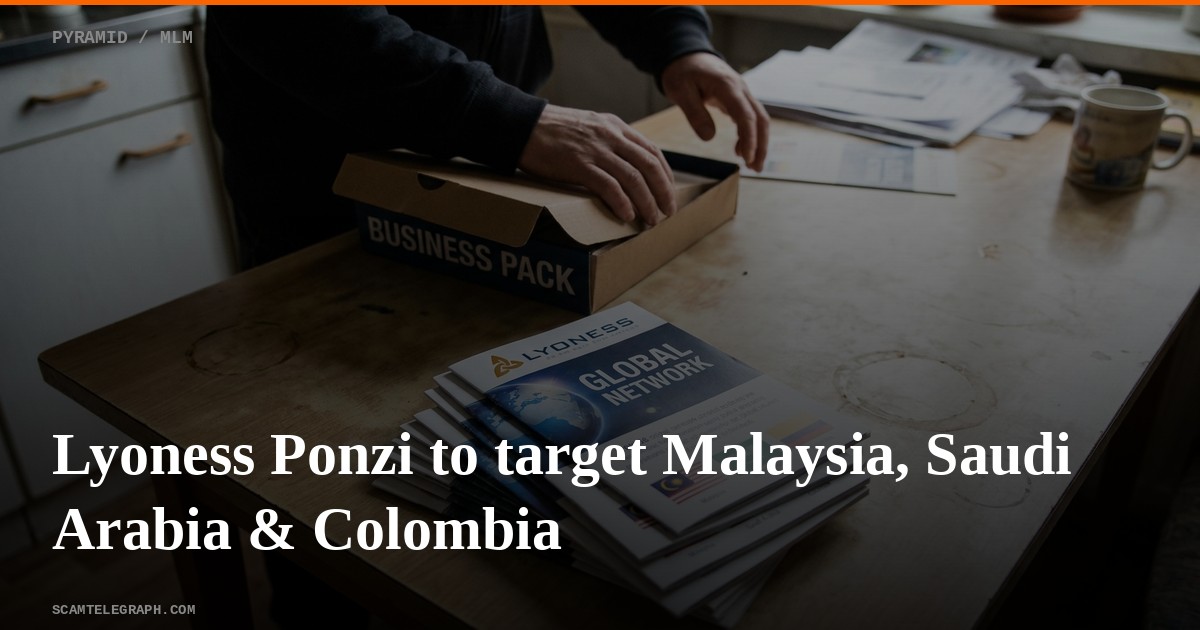
Lyoness President Daniel Gergics announced plans to expand the company's "Cashback World" investment scheme into Malaysia, Saudi Arabia, and Colombia. This move follows intense regulatory scrutiny and unfavorable court rulings in Europe, particularly Italy's outright ban on the operation.
The company is actively recruiting existing affiliates to pre-load "balance program" units in these new territories. This strategy allows established members, often referred to as uplines, to secure early positions before local investors are targeted. Such pre-investment can range from €5,000 to €15,000 per country, with higher tiers costing substantially more.
This expansion mirrors Lyoness's long-standing modus operandi. The organization typically launches an investment scheme in a country, faces regulatory intervention or collapse, and then relocates to a new jurisdiction. Existing victims from prior markets are then persuaded to invest in the new venture, effectively placing them at the top of the latest iteration of the scheme.
Gergics indicated that the Malaysian market is slated for launch by the end of this year. Saudi Arabia and Colombia are scheduled to open in the subsequent year. This pattern of seeking new markets to sustain operations is a hallmark of Ponzi schemes globally.
The financial implications for individuals involved can be severe. Those who invest in Lyoness's programs are often left with significant losses when the scheme inevitably falters. Regulatory bodies in various countries have issued warnings about Lyoness and similar multi-level marketing operations that promise high returns.
The Italian Competition Authority, for instance, declared Lyoness's Cashback World program an illegal pyramid scheme in 2018. The authority found that the scheme's structure, which heavily incentivizes recruitment over actual product sales or services, was characteristic of a Ponzi operation. Similar concerns have been raised by financial regulators in other European nations.
Victims of such schemes often face a difficult path to recovery. Funds are frequently moved rapidly between jurisdictions, making asset tracing and seizure complex. Legal recourse can be lengthy and costly, with no guarantee of recouping invested capital.
For individuals in Malaysia, Saudi Arabia, and Colombia, understanding the risks associated with such investment opportunities is crucial. Financial advisors recommend thorough due diligence before committing funds to any program that guarantees unusually high returns or relies heavily on recruitment. Consulting with local financial regulators or consumer protection agencies can provide valuable insights into the legitimacy of investment offers.
 Manoj Kumar