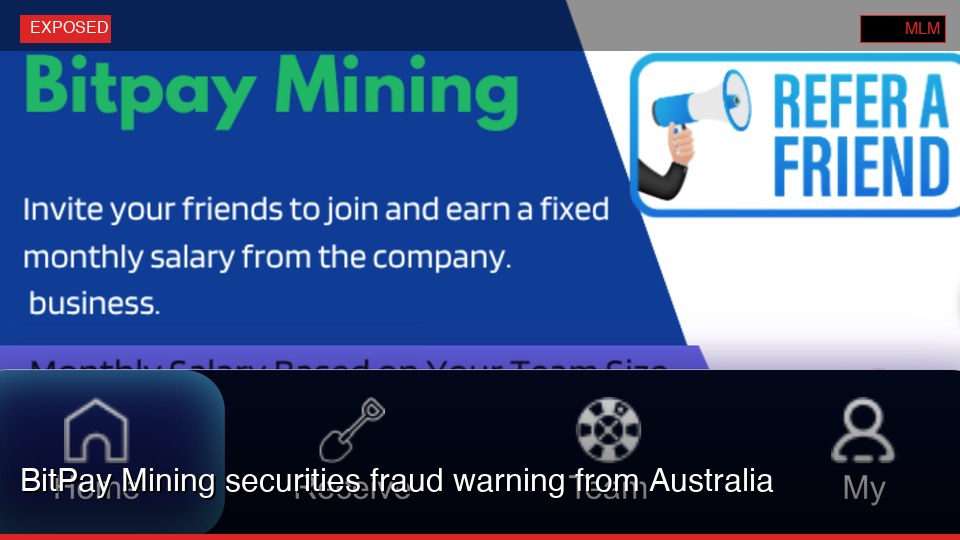
The Australian Securities and Investments Commission (ASIC) issued a securities fraud warning against BitPay Mining on September 9, 2025, adding the entity to its Investor Alert List. ASIC stated BitPay Mining may have offered or advertised financial services to Australian consumers without holding the necessary Australian financial services license or Australian credit license.
Operating without these licenses constitutes securities fraud under Australian Corporations Act 2001 provisions. ASIC’s alert specifically cited "bit185.3wbt.com" as BitPay Mining's primary website. Public records show this domain was last updated on September 27, 2025, just weeks after ASIC's initial public warning. This timing suggests an ongoing, active online presence despite regulatory scrutiny.
BitPay Mining operates as a "click a button" app Ponzi scheme, a common form of investment fraud frequently linked to Chinese scam networks. These schemes typically entice users with promises of high, consistent daily returns for minimal effort. Participants often only need to click a button within a mobile application to simulate "mining" or "trading" activity. The illusion of profitability is maintained by paying early investors with funds from later participants, a classic Ponzi structure that inevitably collapses when new money stops flowing in.
The lack of proper licensing means consumers engaging with BitPay Mining have no regulatory protection. Australian financial services laws, enshrined in the Corporations Act, mandate that entities dealing with investments be licensed. This ensures they meet specific capital adequacy, compliance, and dispute resolution standards designed to protect investors. Without these foundational safeguards, investors face a significant risk of total capital loss, with little recourse for recovery. ASIC's role includes maintaining a public register of licensed entities, a critical tool for consumers to verify legitimacy.
This warning comes amid a broader global regulatory crackdown on fraudulent cryptocurrency-related investment schemes. In December 2025, just months before ASIC’s action, the U.S. Securities and Exchange Commission (SEC) filed a lawsuit against VBit Mining and its founder, Danh Vo, in a Delaware federal court. The SEC alleged Vo misappropriated approximately $48.5 million from investors between 2018 and 2022. VBit had promised passive income from cryptocurrency mining equipment, misleading investors by selling more hosting agreements than actual mining rigs. Investors were led to believe their funds were generating returns from legitimate, operational mining facilities.
The VBit case, like BitPay Mining, shows pervasive deceptive practices in the digital asset space. Scammers frequently exploit public interest in cryptocurrencies and mining by creating elaborate online fronts that lack genuine underlying economic activity. These operations often use sophisticated online platforms, social media, and aggressive marketing to attract victims, making it difficult for average investors to distinguish legitimate opportunities from scams. Regulators worldwide, including ASIC and the SEC, continue to issue warnings and take enforcement actions against such illicit schemes.
ASIC encourages all Australian consumers to verify the licensing status of any financial service provider through its official registers before committing funds. Engaging with unlicensed entities carries substantial risk, and recovering lost investments can prove extremely difficult, if not impossible. Individuals who believe they have been targeted by BitPay Mining or similar schemes should report the activity to ASIC and consider contacting their bank or financial institution for advice on potential recovery steps. The Commission’s Investor Alert List serves as a public resource for identifying potential scams and unauthorized firms, providing a crucial first line of defense for consumers.